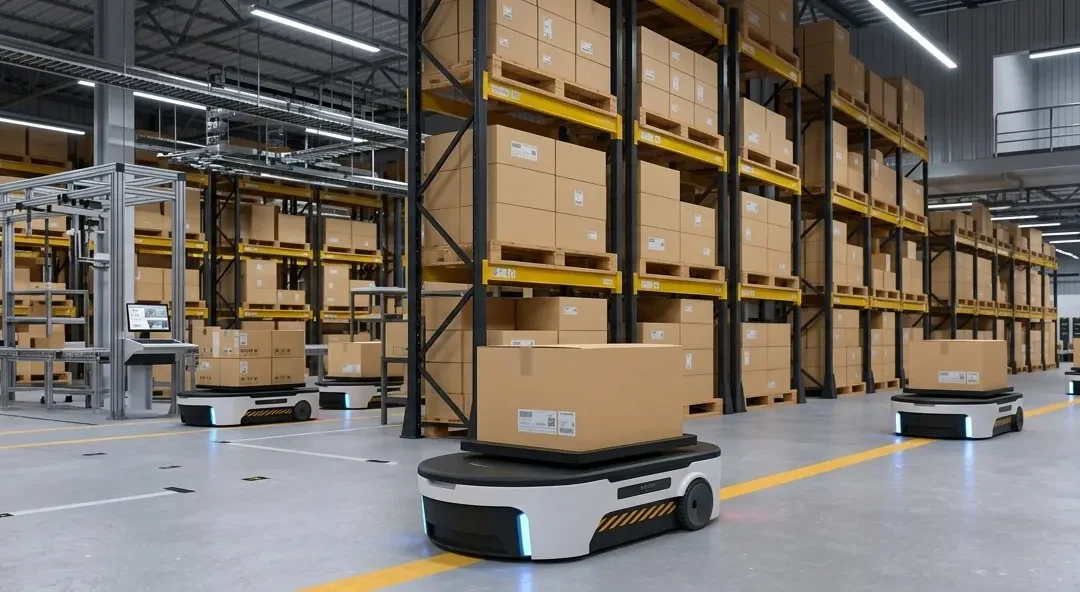
Industrial facilities depend on the smooth movement of materials. Raw materials, components, bins, pallets, work-in-progress goods, finished products, and packaging materials must move between storage areas, production lines, assembly stations, quality inspection zones, warehouses, and dispatch areas.
When this movement depends heavily on manual labor, trolleys, forklifts, or traditional transport methods, businesses often face delays, safety risks, worker fatigue, inconsistent delivery, and poor visibility across internal logistics.
This is where Autonomous Mobile Robots, also known as AMRs, are becoming an important part of modern industrial automation.
Autonomous Mobile Robots help factories, warehouses, and logistics facilities automate internal material movement without depending on fixed tracks or heavy infrastructure changes. They can move intelligently through industrial environments, avoid obstacles, support flexible workflows, and improve overall operational efficiency.
This complete guide explains what Autonomous Mobile Robots are, how they work, where they are used, what benefits they provide, and how to choose the right AMR solution for industrial material movement.
What Are Autonomous Mobile Robots?
Autonomous Mobile Robots are intelligent robotic vehicles that move materials independently inside factories, warehouses, distribution centers, and industrial facilities.
Unlike traditional guided vehicles that follow fixed paths, AMRs use sensors, mapping technology, cameras, LiDAR, onboard software, and navigation systems to understand their surroundings and choose safe movement routes.
An AMR can move from one point to another, detect obstacles, slow down, stop, or reroute depending on the operating environment. This makes AMRs suitable for dynamic industrial spaces where people, machines, racks, pallets, and equipment may be moving at the same time.
In simple terms, an AMR is a smart robot designed to move materials safely and efficiently inside a facility.
Why Autonomous Mobile Robots Are Important for Industrial Material Movement
Industrial material movement directly affects productivity. If materials do not reach the right place at the right time, production may slow down, workers may wait, machines may remain idle, and dispatch schedules may be delayed.
Many facilities still depend on manual movement methods such as:
- Hand trolleys
- Pallet trucks
- Forklifts
- Manual carrying
- Operator-driven carts
- Verbal coordination
- Paper-based material movement requests
These methods can become inefficient as operations grow.
Autonomous Mobile Robots help solve these challenges by automating repetitive internal transport tasks. They make material movement more consistent, trackable, and scalable.
AMRs are especially useful for industries that want to improve internal logistics without completely redesigning their factory or warehouse layout.
How Autonomous Mobile Robots Work
Autonomous Mobile Robots work through a combination of hardware, software, sensors, and navigation intelligence.
The robot receives a task, identifies the pickup and drop-off location, calculates a safe route, moves through the facility, avoids obstacles, completes the delivery, and updates the system.
Core Technologies Used in AMRs
Sensors
AMRs use sensors to detect objects, people, machines, racks, pallets, and other obstacles in their path. These sensors help the robot move safely in shared industrial environments.
Lidar
LiDAR helps the robot scan its surroundings and create a digital understanding of the environment. It supports accurate navigation and obstacle detection.
Cameras
Some AMRs use cameras for object detection, environment recognition, barcode reading, or visual navigation support.
Mapping Software
Mapping software helps create a digital map of the facility. The AMR uses this map to understand routes, restricted zones, pickup points, drop-off points, and charging stations.
Navigation System
The navigation system helps the AMR choose the best route, avoid obstacles, and adjust movement in real time.
Fleet Management Software
Fleet management software controls multiple AMRs. It assigns tasks, manages traffic, monitors robot status, tracks battery levels, and improves route efficiency.
Battery and Charging System
AMRs operate on rechargeable batteries. Depending on the system, they may use manual charging, opportunity charging, or automatic charging stations.
AMR vs AGV: What Is the Difference?
Many businesses compare AMRs with AGVs before choosing a material handling automation system.
An AGV, or Automated Guided Vehicle, usually follows fixed routes using magnetic tape, wires, reflectors, QR codes, or predefined paths.
An AMR, or Autonomous Mobile Robot, navigates more flexibly using sensors, mapping, and intelligent route planning.
| Factor | AMR | AGV |
|---|---|---|
| Navigation | Flexible and intelligent | Fixed or predefined |
| Infrastructure | Usually lower | May require route infrastructure |
| Obstacle Handling | Can detect and reroute | Often stops until path is clear |
| Layout Flexibility | High | Limited |
| Best Use | Dynamic material movement | Fixed repetitive movement |
| Scalability | Easier to scale | Route-dependent |
| Setup Flexibility | Higher | More structured |
AMRs are best when a facility needs flexibility. AGVs are best when routes are fixed and repetitive.
Common Applications of Autonomous Mobile Robots in Industry
Autonomous Mobile Robots can support many material movement tasks across factories, warehouses, and logistics operations.
AMRs for Raw Material Movement
AMRs can move raw materials from storage areas to production zones. This helps reduce manual transport and ensures materials are available when needed.
AMRs for Line Feeding
Line feeding is one of the most common AMR applications. AMRs can deliver components, bins, totes, tools, or parts directly to production or assembly lines.
This reduces worker movement and helps production teams stay focused on manufacturing tasks.
AMRs for Work-in-Progress Movement
In manufacturing plants, work-in-progress materials often move between different production stages. AMRs can automate this movement and improve process continuity.
AMRs for Finished Goods Transport
After production, finished goods need to move to packing, storage, inspection, or dispatch areas. AMRs can handle these repetitive transfers efficiently.
AMRs for Warehouse Replenishment
In warehouses, AMRs can support replenishment by moving goods from storage zones to picking, packing, or staging areas.
AMRs for Picking Support
AMRs can assist warehouse workers by transporting picked items, reducing walking distance, and improving order processing speed.
AMRs for Dispatch and Staging
AMRs can move goods to dispatch areas, helping warehouses and factories prepare shipments more efficiently.
AMRs for Multi-Point Delivery
AMRs are useful when materials need to move between multiple pickup and drop-off points across a facility.
Industries That Use Autonomous Mobile Robots
Autonomous Mobile Robots are suitable for many industries because material movement is a common challenge across industrial environments.
Manufacturing
Manufacturing plants use AMRs for line feeding, raw material movement, WIP movement, component delivery, and finished goods transfer.
Warehousing and Logistics
Warehouses use AMRs for inventory movement, picking support, replenishment, packing support, and dispatch flow.
Automotive Components
Automotive component facilities use AMRs to move parts between storage, assembly, inspection, and dispatch areas.
FMCG and Consumer Goods
FMCG facilities use AMRs for packaging support, warehouse transfer, and finished goods movement.
Electronics and Electrical Manufacturing
Electronics facilities use AMRs for careful movement of components, kits, tools, and assembly materials.
Pharmaceuticals and Healthcare Manufacturing
Pharma and healthcare facilities can use AMRs for controlled movement of materials, packaging items, and internal logistics support.
Heavy Engineering
Engineering facilities may use AMRs for transporting components, tools, bins, and production support materials.
Benefits of Autonomous Mobile Robots for Industrial Material Movement
Improved Material Flow
AMRs help materials move smoothly between departments, production areas, warehouses, and dispatch zones. This reduces delays and improves workflow continuity.
Reduced Manual 3
By automating repetitive transport tasks, AMRs reduce the need for workers to carry, push, pull, or transport materials manually.
Better Workplace Safety
AMRs reduce manual lifting, long-distance carrying, forklift dependency, and repetitive movement. Their sensors and obstacle detection systems also support safer movement in shared spaces.
Higher Productivity
When AMRs manage material transport, workers can focus on higher-value tasks such as production, inspection, machine operation, planning, and supervision.
Flexible Automation
AMRs can adapt to changing routes, layouts, and pickup/drop requirements. This makes them suitable for modern facilities where operations evolve over time.
Reduced Forklift Dependency
AMRs can reduce the need for forklifts in repetitive internal movement tasks, helping improve safety and reduce traffic congestion.
Real-Time Visibility
AMRs can be connected to software dashboards that show robot location, job status, route performance, battery level, and task completion.
Scalable Operations
Businesses can start with a small AMR fleet and expand gradually as production volume or warehouse activity increases.
Better Resource Utilization
AMRs allow workers to focus on skilled tasks while robots manage repetitive movement. This improves overall workforce allocation.
Support for Industry 4.0
AMRs can integrate with ERP, WMS, MES, fleet management systems, and digital dashboards to support connected manufacturing and smart warehouse operations.
Key Features to Look for in an Autonomous Mobile Robot
Choosing the right AMR requires more than checking payload capacity. The robot must match your facility, material type, safety needs, and integration requirements.
Payload Capacity
The AMR should be able to safely carry the required load. Payload requirements may vary for bins, totes, pallets, cartons, components, or finished goods.
Navigation Technology
Check whether the AMR uses LiDAR, cameras, SLAM, QR codes, sensors, or hybrid navigation systems.
Obstacle Detection
The robot should detect people, machines, racks, pallets, and unexpected objects in its path.
Battery Life
Battery capacity should support your shift duration, travel distance, and task frequency.
Charging Method
Evaluate whether the robot uses manual charging, automatic charging, or opportunity charging.
Fleet Management
If multiple robots are required, fleet management software is essential for task assignment, traffic control, and monitoring.
Integration Capability
The AMR should integrate with ERP, WMS, MES, production systems, or warehouse software if required.
Safety Features
Important safety features include emergency stop, speed control, warning lights, audible alerts, safety sensors, and restricted zone control.
Load Handling Attachment
AMRs may need top modules, conveyors, lift platforms, carts, racks, tugger systems, or pallet handling attachments depending on the application.
Scalability
The system should allow additional robots, routes, and workflows to be added later.
How to Choose the Right AMR for Your Facility
Before selecting an Autonomous Mobile Robot, businesses should conduct a proper operational study.
Step 1: Map Your Material Flow
Identify where materials move, how often they move, and which routes create delays.
Ask:
- What materials need to be transported?
- Where are pickup and drop points located?
- How often does the movement happen?
- What distance does the robot need to travel?
- Are the routes fixed or changing?
- Which movements are repetitive?
Step 2: Define Load Requirements
Document load weight, size, shape, packaging, stability, and handling method.
Step 3: Evaluate Facility Layout
Study aisle width, turning space, floor condition, pedestrian zones, forklift routes, doors, slopes, and charging areas.
Step 4: Identify Safety Risks
Review worker movement, traffic zones, blind spots, crossings, machine areas, and emergency routes.
Step 5: Decide Integration Needs
Check whether the AMR must connect with ERP, WMS, MES, fleet software, barcode systems, or production planning tools.
Step 6: Calculate ROI
Compare investment against expected benefits such as reduced manual handling, faster movement, fewer delays, improved safety, and better productivity.
Step 7: Plan for Future Growth
Choose an AMR system that can expand as your facility grows.
AMR Implementation Process
A successful AMR project requires structured planning and execution.
Site Assessment
The automation team studies the facility layout, material flow, movement frequency, safety conditions, and current process challenges.
Feasibility Study
The team identifies which tasks can be automated and whether AMRs are the right solution.
Solution Design
The AMR type, payload, attachment, routes, charging plan, software integration, and safety requirements are defined.
Mapping and Route Planning
The facility is mapped digitally, and pickup points, drop points, restricted zones, charging stations, and routes are configured.
Integration
The AMR system is connected with fleet management software and other business systems if needed.
Testing
The robots are tested for navigation, safety response, load movement, route performance, and task accuracy.
Training
Operators and workers are trained on AMR usage, safety practices, monitoring, and basic troubleshooting.
Optimization
After deployment, performance data is reviewed to improve routes, task assignments, charging schedules, and movement efficiency.
Common Mistakes to Avoid When Implementing AMRs
Choosing AMRs Without Studying Material Flow
AMRs should solve a specific movement problem. Without material flow analysis, the system may not deliver expected results.
Ignoring Load Details
Payload, dimensions, center of gravity, and load stability must be clearly understood before robot selection.
Overlooking Facility Conditions
Poor floor quality, narrow aisles, congestion, or unsafe crossings can affect AMR performance.
Not Planning Software Integration
Manual task assignment may reduce the value of AMR automation. Integration improves efficiency and visibility.
Skipping Worker Training
Employees should understand how AMRs operate and how to work safely around them.
Focusing Only on Initial Cost
The cheapest AMR may not offer the best long-term value. Reliability, support, scalability, and integration matter.
Not Planning for Expansion
Choose a system that can support more robots, routes, and workflows in the future.
AMR Safety in Industrial Environments
Safety is one of the most important advantages of Autonomous Mobile Robots.
AMRs are designed to operate in shared spaces with people and equipment. They use sensors and navigation systems to reduce collision risks and support controlled movement.
Important AMR safety features include:
- Obstacle detection
- Emergency stop buttons
- Speed control
- Warning lights
- Audio alerts
- Safety scanners
- Restricted zone settings
- Automatic stopping
- Route monitoring
- Fleet traffic control
However, safe AMR operation also depends on proper implementation. Facilities should define robot routes, pedestrian zones, safety rules, training procedures, and emergency response methods.
Frequently Asked Questions About Autonomous Mobile Robots
What is an Autonomous Mobile Robot?
An Autonomous Mobile Robot is an intelligent robot that moves materials independently inside a factory, warehouse, or industrial facility using sensors, mapping, and navigation software.
How do Autonomous Mobile Robots work?
AMRs use sensors, LiDAR, cameras, mapping software, and navigation systems to understand their environment, detect obstacles, choose routes, and move materials safely.
What are AMRs used for in industrial material movement?
AMRs are used for line feeding, raw material movement, work-in-progress transfer, bin transport, warehouse replenishment, finished goods movement, and dispatch support.
What is the difference between AMR and AGV?
AMRs navigate flexibly using sensors and mapping, while AGVs usually follow fixed or predefined routes. AMRs are better for dynamic environments, and AGVs are better for repetitive fixed-route movement.
Are Autonomous Mobile Robots safe around workers?
Yes. AMRs are designed with safety features such as obstacle detection, speed control, emergency stop buttons, warning lights, safety sensors, and route monitoring.
Can AMRs reduce manual material handling?
Yes. AMRs automate repetitive internal transport tasks, reducing the need for workers to manually carry, push, pull, or move materials across long distances.
Can AMRs work in existing factories?
Yes. AMRs can often be implemented in existing factories after a proper site assessment, layout review, route planning, and safety evaluation.
Do AMRs require fixed tracks?
No. Most AMRs do not require fixed tracks. They use mapping and navigation technologies to move flexibly through the facility.
Can AMRs integrate with ERP or WMS systems?
Yes. AMRs can integrate with ERP, WMS, MES, fleet management software, production systems, barcode systems, and monitoring dashboards.