Automated Guided Vehicle (AGV Automation Systems)
Modern industries are rapidly adopting Automated Guided Vehicles (AGVs) to improve productivity, reduce manual handling, and ensure operational safety.
An Automated Guided Vehicle is a battery-powered, computer-controlled vehicle that follows a programmed path to transport materials within factories, warehouses, and distribution centers.At Synergy Automatics, we design and manufacture advanced AGV systems in Chennai, India, built to meet the unique requirements of Indian industries.
Our AGV automation systems utilize laser guidance, magnetic tape, or vision-based navigation to move materials precisely and safely — ensuring a smarter, leaner, and safer workspace.
How Automated Guided Vehicles Work (Working Principle)
Automated Guided Vehicles (AGVs) move materials autonomously using navigation sensors, control software, and PLC-based systems.
They follow magnetic, laser, or vision-guided paths to ensure accurate and collision-free transport.
A central control or IoT fleet system manages multiple AGVs, coordinating routes and speed in real time.
Powered by lithium-ion batteries with auto-docking chargers, AGVs operate continuously while maintaining safety through LIDAR and ultrasonic sensors that detect and avoid obstacles.
Types of Automated Guided Vehicles (AGVs)
Different industries require different stacking mechanisms depending on load, height, and precision.
Below are the main types of stacker machines and their specific applications in real industrial environments.

1. Towing / Tow Tractor AGV
- A Towing AGV (Tow Tractor AGV) is engineered to pull multiple carts or trolleys connected in a train configuration for long-distance material transfer. These vehicles operate using AC servo-driven traction motors and differential steering control, providing smooth torque and precision movement.
- With towing capacities ranging from 500 kg to 10 tons, the system is ideal for automotive line feeding, warehouse logistics, and distribution centers.
- Equipped with magnetic or laser guidance, a PLC-based control unit, and LIDAR safety sensors, Tow AGVs ensure high throughput with minimal human involvement.
2. Unit Load AGV
- A Unit Load AGV is designed to handle pallets, racks, or containers placed on a built-in platform or conveyor deck. These AGVs feature servo-controlled lifting tables or scissor mechanisms for smooth transfer between stations.
- With a payload capacity of 500 kg to 3,000 kg, they operate on laser or hybrid navigation for ±5 mm positioning accuracy.
- The system integrates with warehouse management software (WMS) for job assignment and route optimization.
- Commonly deployed in manufacturing plants, logistics centers, and palletizing lines, Unit Load AGVs deliver consistent, precise, and automated load handling.


3. Forklift AGV
- A Forklift AGV replicates the functions of a manual forklift but operates autonomously using laser navigation and sensor-based positioning.
- It features a servo-driven mast and hydraulic fork assembly capable of lifting loads up to 3.5 meters high and weighing between 500 kg and 2,500 kg.
- The system is powered by lithium-ion batteries with auto-charging capability, ensuring uninterrupted operation.
- Safety components such as pallet detection scanners, bump sensors, and emergency brakes enable safe operation even in dynamic environments.
- These AGVs are ideal for automated pallet stacking, warehouse retrieval, and truck loading operations.
4. Cart / AGC (Automated Guided Cart)
- Automated Guided Carts (AGCs) are compact AGVs designed for light material transport and repetitive tasks within factories.
- They operate using magnetic strip or QR-code navigation, powered by brushless DC servo drives that ensure low noise and maintenance-free operation.
- Typical payloads range from 50 kg to 500 kg, with travel speeds of up to 2 m/s.
- AGCs are ideal for assembly lines, tool movement, and packaging units, offering quick installation and scalable deployment.
- Their small footprint, differential drive, and front proximity sensors make them perfect for tight spaces and lean manufacturing setups.
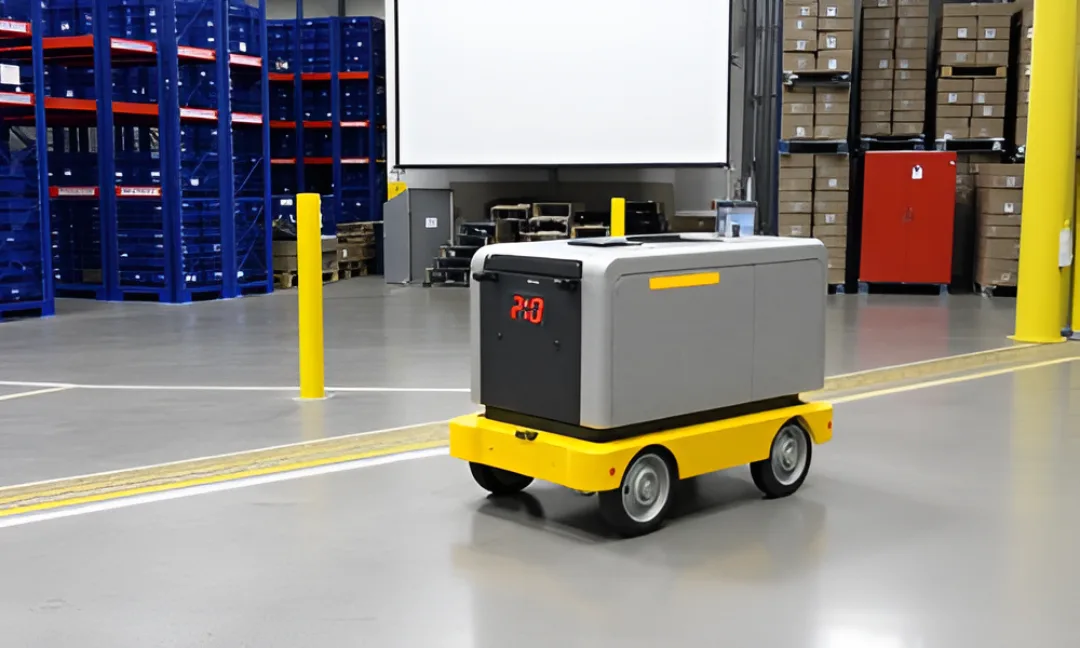

5. Heavy Burden Carrier AGV
- A Heavy Burden Carrier AGV is built for transporting extremely heavy or oversized components such as molds, dies, or metal coils.
- These AGVs feature a multi-wheel traction system with synchronized servo motors for torque distribution and stability.
- They can carry loads ranging from 5 to 50 tons, guided by laser or natural contour navigation systems.
- The chassis is constructed from reinforced structural steel, while omni-directional or pivot steering enables precise movement even in confined spaces.
- They are extensively used in steel, foundry, aerospace, and heavy equipment manufacturing industries for safe and efficient handling.
6. Hybrid / Dual Mode AGV
- Hybrid AGVs provide the flexibility to operate in both automatic and manual modes, giving operators control when needed.
- These systems use servo-assisted steering, proportional braking, and a touchscreen interface for mode switching.
- Hybrid AGVs are powered by smart lithium battery packs with onboard Battery Management Systems (BMS) for efficiency and longevity.
- They are ideal for semi-automated production environments, allowing manual overrides during maintenance, setup, or shared human-machine workspaces.
- With integrated PLC safety logic and IoT monitoring, these AGVs ensure a smooth transition between operation modes without losing positional accuracy.

Applications of AGV Automation
Warehouse and logistics automation
Automotive part feeding and transfer
Production line and assembly automation
Cleanroom and hospital logistics
Palletizing and packaging lines
Pharmaceutical and food processing plants
Foundry and fabrication industry
Benefits of Using AGVs
24×7 operation with zero downtime
Reduced human dependency and risk
Improved efficiency and accuracy
Real-time tracking and material traceability
Seamless integration with ERP and WMS systems
Modular and scalable system design
Why Choose Synergy Automatics
Made in India Manufacturing
Built in Chennai for Indian industries.
Integration Expertise
Compatible with conveyors, WMS, and CNC lines.
Turnkey Solutions
From concept to commissioning with single-point accountability.
Customizable Navigation
Choose from magnetic, laser, or vision-guided models.
Local Support Network
Service and training across India.
FAQs – Automated Guided Vehicles (AGV) Automation Systems
1. What is an Automated Guided Vehicle (AGV)?
- An Automated Guided Vehicle (AGV) is a battery-powered, computer-controlled mobile system used to transport materials autonomously within factories, warehouses, or production areas.
- It uses sensors and navigation technologies like magnetic tape, lasers, or cameras to move along a predefined path without manual intervention.
2. How does an AGV system work?
AGVs operate through navigation sensors, PLC control units, and IoT fleet management software.
They follow magnetic, laser, or vision-based routes, and use LIDAR and ultrasonic sensors for obstacle detection.
These vehicles automatically pick up, transport, and deliver materials with high accuracy and safety.
3. What are the main types of Automated Guided Vehicles?
The major types of AGVs include:
- Towing / Tow Tractor AGVs – pull multiple carts.
- Unit Load AGVs – move pallets or racks.
- Forklift AGVs – lift and stack pallets.
- Cart / AGCs – small, light-duty vehicles for part transfer.
- Heavy Burden Carriers – handle heavy loads and molds.
- Hybrid / Dual Mode AGVs – operate in both manual and automatic modes.
4. What are the advantages of AGV automation?
AGVs enhance efficiency, safety, and accuracy while reducing labor costs.
They enable 24×7 material flow, improve traceability, and reduce accidents through built-in sensors.
Their modular design allows easy scalability for future automation expansion.
5. Where are AGVs commonly used?
AGVs are used in various industries including:
- Automotive manufacturing and assembly lines
- Warehousing and logistics centers
- FMCG and pharmaceutical production
- Steel, foundry, and heavy equipment factories
- Cold storage and packaging units.
6. What is the difference between AGV and AMR?
An AGV follows predefined paths (like magnetic or laser-guided tracks), while an AMR (Autonomous Mobile Robot) can navigate freely using sensors and mapping algorithms.
AGVs are ideal for structured environments, whereas AMRs suit dynamic layouts that require flexibility.
7. What is the price range of AGV systems in India?
The cost of an AGV system in India typically ranges from ₹5 lakh for compact carts to ₹25 lakh or more for large forklift or heavy-duty models.
Price depends on payload capacity, navigation technology, automation level, and custom integration.
8. Can AGVs be customized for specific industrial needs?
- Yes
- Synergy Automatics designs and manufactures custom AGV solutions in Chennai, tailored to plant layouts, load capacities, and control systems.
- We provide end-to-end services from design and programming to commissioning and maintenance.
9. Are AGVs safe to operate around human workers?
- Yes. AGVs are equipped with LIDAR scanners, ultrasonic sensors, and emergency brakes to detect obstacles and stop immediately if a person or object is nearby.
- These features make them extremely safe for human-machine collaborative environments.
10. How can Synergy Automatics help implement AGV automation?
Synergy Automatics offers turnkey AGV automation solutions — including system design, manufacturing, programming, and after-sales support.
Our AGV systems are engineered in Chennai, India, ensuring cost-effective performance, reliability, and full local service support.