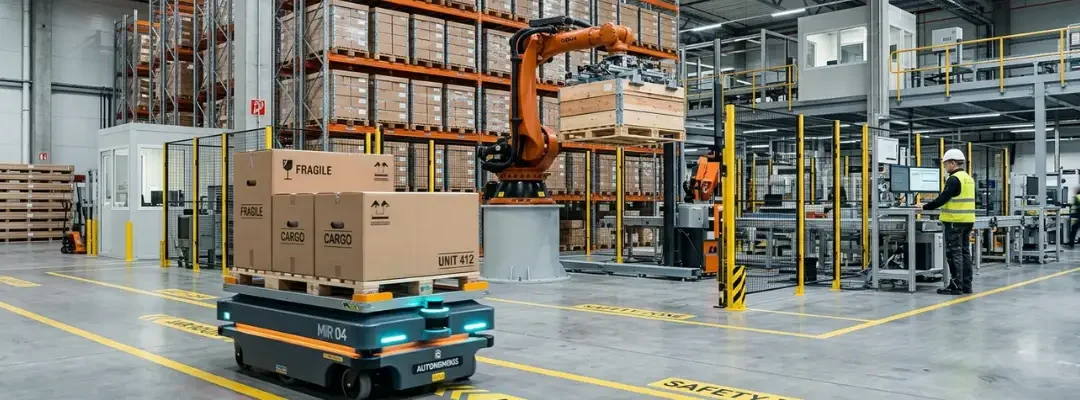
Industrial material handling is one of the most safety-sensitive areas inside manufacturing plants, warehouses, logistics centers, and distribution facilities. Every day, workers move raw materials, pallets, bins, components, finished goods, and heavy loads between storage areas, production lines, inspection zones, packing sections, and dispatch points.
When these tasks depend heavily on manual labor, forklifts, pallet trucks, or repetitive movement, the risk of workplace injuries increases. Common problems include lifting strain, fatigue, collisions, product drops, unsafe traffic flow, and poor visibility across internal logistics.
Robotics is changing this situation by automating repetitive and high-risk material movement tasks. Technologies such as Autonomous Mobile Robots, Automated Guided Vehicles, and material handling robots help improve workplace safety while also increasing operational efficiency.
This article explains how robotics improves safety in industrial material handling operations, where it creates the most value, and what businesses should consider before implementation.
Why Safety Matters in Industrial Material Handling
Material handling is not just a productivity function. It directly affects worker safety, operational continuity, product quality, and equipment reliability.
In many factories and warehouses, workers are required to lift, push, pull, carry, stack, load, unload, or transport materials repeatedly throughout the day. Over time, this can lead to injuries, fatigue, and reduced operational performance.
Unsafe material handling can result in:
- Back, shoulder, and muscle injuries
- Forklift and pedestrian collisions
- Dropped or damaged materials
- Slips, trips, and falls
- Worker fatigue and reduced concentration
- Production delays caused by accidents
- Higher compensation and downtime costs
A safer material handling process reduces risk while helping the facility maintain smoother operations.
Common Safety Risks in Manual Material Handling Operations
Before implementing robotics, businesses should understand where safety risks usually occur.
Manual Lifting and Carrying Injuries
Manual lifting is one of the most common causes of strain injuries in industrial environments. Workers who repeatedly lift boxes, components, tools, or materials may experience back pain, shoulder strain, joint stress, or long-term musculoskeletal issues.
Forklift and Vehicle Movement Risks
Forklifts are useful but can create major safety hazards in busy facilities. Risks include blind-spot collisions, pedestrian accidents, rack impacts, speeding, load instability, and operator fatigue.
Repetitive Motion and Fatigue
Tasks such as pushing trolleys, pulling carts, walking long distances, bending, and carrying loads can create fatigue. Tired workers are more likely to make mistakes or miss hazards.
Congested Internal Traffic Areas
Warehouses and factories often have shared movement zones where workers, forklifts, pallet trucks, machines, and materials operate together. Without proper flow control, these zones become accident-prone.
Load Instability and Handling Errors
Improper loading, uneven weight distribution, incorrect stacking, or rushed movement can cause goods to fall, shift, or become damaged during transport.
How Robotics Improves Safety in Industrial Material Handling
Robotics improves safety by reducing worker exposure to risky, repetitive, and physically demanding tasks. Instead of relying on people to move materials manually across the facility, robots perform these movements in a controlled, consistent, and trackable way.
Robotic material handling systems improve safety by:
- Reducing manual lifting
- Lowering forklift dependency
- Minimizing repetitive strain
- Improving traffic control
- Supporting safer movement paths
- Reducing fatigue-related errors
- Improving load handling consistency
- Providing real-time movement visibility
This makes robotics valuable for both manufacturing and warehouse environments.
H2: Reducing Manual Lifting and Physical Strain with Material Handling Robots
One of the strongest safety benefits of robotics is the reduction of manual lifting and carrying.
Material handling robots can move bins, totes, pallets, containers, components, and finished goods between operational areas. This reduces the need for workers to physically carry or push loads across long distances.
Safety Impact
Robotics helps reduce:
- Back strain
- Shoulder injuries
- Muscle fatigue
- Repetitive stress injuries
- Long-distance carrying risks
- Unsafe lifting posture
Practical Example
In a manufacturing plant, instead of workers manually moving components from storage to assembly stations multiple times per shift, an AMR can transport the components automatically. Workers can then focus on assembly, inspection, or supervision instead of repetitive material movement.
Improving Worker Safety with Autonomous Mobile Robots
Autonomous Mobile Robots, or AMRs, are useful in dynamic environments where routes and movement patterns may change.
AMRs use sensors, mapping, and obstacle detection technologies to move safely around people, equipment, racks, and other objects. If an obstacle appears, the AMR can slow down, stop, or choose another route depending on the system design.
AMR Safety Features
AMRs may include:
- Obstacle detection
- Real-time navigation
- Automatic route adjustment
- Speed control
- Emergency stop buttons
- Warning lights
- Audible alerts
- Fleet monitoring software
Best Use Case
AMRs are ideal for facilities where workers and machines share movement areas and where material movement routes are not always fixed.
Improving Safety in Fixed Routes with Automated Guided Vehicles
Automated Guided Vehicles, or AGVs, are useful for structured facilities where materials move along fixed routes.
AGVs follow predefined paths and are commonly used for pallet movement, line feeding, heavy load transport, and warehouse-to-production transfers.
AGV Safety Features
AGVs may include:
- Safety scanners
- Fixed route control
- Emergency stop systems
- Controlled speed zones
- Defined pickup and drop points
- Warning signals
- Load handling controls
Best Use Case
AGVs are ideal for repetitive material movement between fixed points, especially in facilities that want predictable and controlled internal transport.
Important Safety Features to Look for in Material Handling Robots
When choosing a robotic material handling system, safety features should be evaluated carefully.
Obstacle Detection
Robots should detect people, machines, racks, pallets, and other objects in their path.
Emergency Stop Function
Emergency stop buttons allow workers or operators to stop the robot immediately when required.
Speed Control
Robots should be able to reduce speed in high-traffic, narrow, or sensitive areas.
Warning Lights and Sound Alerts
Visual and audio signals help workers identify robot movement and understand nearby activity.
Route Management
Proper route planning helps reduce crossing conflicts and unsafe movement patterns.
Load Safety
The robot should be suitable for the load type, size, weight, and stability requirements.
Fleet Management Software
Centralized monitoring helps coordinate multiple robots safely across the facility.
Frequently Asked Questions About Robotics and Material Handling Safety
How does robotics improve safety in material handling?
Robotics improves safety by automating repetitive and physically demanding material movement tasks. This reduces manual lifting, worker fatigue, forklift dependency, and handling-related injuries.
Can robots reduce workplace injuries in factories?
Yes. Robots can reduce injuries caused by lifting, carrying, pushing, pulling, bending, repetitive walking, and manual material transport.
Are AMRs safe to use around workers?
Yes. AMRs are designed with safety features such as sensors, obstacle detection, speed control, emergency stop buttons, warning lights, and route management systems.
Are AGVs safer than forklifts?
AGVs can reduce safety risks in repetitive transport tasks because they follow controlled routes and operate with safety scanners, speed limits, and emergency stop systems.
What safety features should material handling robots have?
Material handling robots should include obstacle detection, emergency stop, speed control, warning lights, safety scanners, route control, load stability features, and monitoring software.
Can robotics improve warehouse safety?
Yes. Warehouse robots can reduce manual transport, long walking distances, aisle congestion, picking fatigue, forklift movement, and unsafe material handling practices.
Do robots replace workers in material handling?
Robots usually handle repetitive, physically demanding, and high-risk movement tasks. Workers can then focus on supervision, quality control, machine operation, planning, and other skilled activities.
Is robotic material handling suitable for small and medium factories?
Yes. Small and medium factories can start with one or two robotic systems for repetitive transport tasks and expand automation gradually as operations grow.
How do robots prevent forklift accidents?
Robots reduce forklift dependency by taking over repetitive movement tasks. This lowers forklift traffic, reduces blind-spot risks, and creates safer material movement patterns.
How should a company start with robotics for safety improvement?
A company should start with a site assessment, identify high-risk material handling tasks, study material flow, evaluate load requirements, and then select the right AMR, AGV, or robotic handling solution.