Rooftop Solar Wind Hybrid System
Synergy Automatics provides and installs rooftop dual energy system solar wind system for homes, villas, farmhouses, and commercial properties. Our rooftop hybrid energy systems are designed to combine solar generation and wind energy support in one coordinated setup so users can make better use of available rooftop space while planning a broader renewable energy solution. A rooftop hybrid system is suitable for properties that want more than a standard rooftop solar arrangement. By integrating solar panels and wind support with the right inverter, control system, and optional battery planning, the system can support practical energy use based on site condition, roof space, and project requirement. A properly planned rooftop solar and wind energy system can offer a broader renewable approach than relying only on solar.
Whether the requirement is for a residential building, a farmhouse structure, or a small commercial property, Synergy Automatics helps customers choose the right rooftop hybrid system based on installation feasibility, energy need, and long-term performance goals.
Why Choose a Rooftop Solar Wind Hybrid System?
Makes better use of available rooftop space
Combines solar and wind in one integrated system
Suitable for properties planning rooftop renewable energy use
Can be configured as on-grid, off-grid, or battery-backed
Supports long-term rooftop energy planning
Suitable for residential and commercial rooftops
Offers a broader renewable solution than a single-source setup
Can be planned according to actual load and site condition
A rooftop wind and solar system is a practical option for users who want a more balanced rooftop-based energy setup.
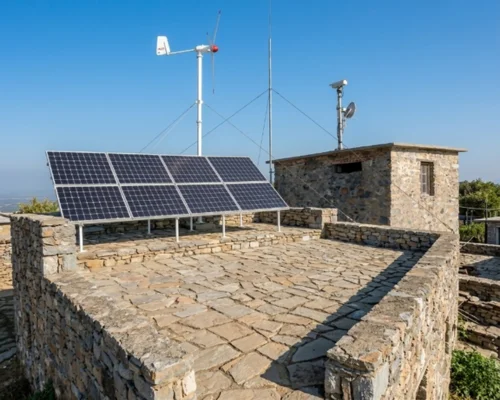
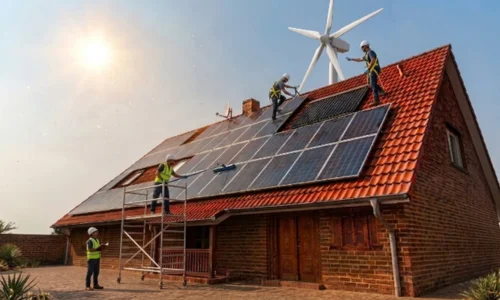
Our rooftop windmill and solar system Service
Synergy Automatics offers complete rooftop windmill and solar system services from planning to installation and commissioning. We study the rooftop condition, understand the power requirement, review the feasibility for solar and wind integration, and provide the right rooftop-based solution according to actual project needs.
- Rooftop condition review
- Requirement study and load assessment
- Solar layout planning based on roof space
- Wind suitability review based on airflow and mounting feasibility
- Inverter and control system selection
- On-grid, off-grid, or backup-based system planning
- Complete installation and commissioning by Synergy Automatics
- Monitoring and electrical protection planning
What Our hybrid rooftop power system Includes
Our rooftop hybrid solution is supplied and installed as a complete coordinated setup. Based on project requirement, the system may include:
Rooftop Solar Array
Solar panels planned according to available rooftop area, energy target, and expected daytime generation.
Wind Integration / Wind Turbine
Wind support planned according to rooftop airflow conditions, mounting feasibility, and realistic renewable contribution. Where feasible, a rooftop wind turbine with solar panels can be integrated as part of the complete system.
Hybrid Inverter
An inverter solution selected for coordinated rooftop solar and wind operation.
Power Management / Controller
Control and management arrangement for handling generation flow, charging coordination, and system operation.
Optional Battery Backup
Battery-ready or battery-backed planning for projects that require support for selected loads.
Mounting Structure
Mounting support designed according to rooftop condition, layout practicality, and installation requirement.
Monitoring and Electrical Protections
Monitoring support, protection planning, and electrical coordination for long-term performance and dependable use.
Applications of Rooftop Solar Wind Hybrid Systems
A rooftop wind turbine with solar panels energy system is suitable for properties where rooftop space, solar exposure, and wind feasibility support a practical renewable energy setup.
Residential Buildings
- Independent houses
- Villas
- Duplex homes
- Gated residential properties
Farmhouse and Rural Buildings
- Farmhouses
- Rural homes
- Semi-rural residential buildings
- Agri-linked buildings
Commercial Buildings
- Offices
- Retail shops
- Clinics
- Small commercial buildings
- Service buildings
Hospitality Properties
- Resorts
- Guest houses
- Lodges
- Retreat properties
Institutional Buildings
- Schools
- Colleges
- Training centres
- Support buildings
- Institutional facilities
How the System Supports Your Property
A rooftop windmill and solar system supports the property by using rooftop solar as the main renewable source and adding wind contribution where rooftop airflow is suitable.During the day, the solar section generates power based on sunlight availability. Where installation conditions allow, wind support adds further renewable contribution.The system can also be planned with optional battery support for selected loads as part of a rooftop hybrid energy system.
Rooftop Hybrid System Options
A rooftop solar wind power system can be planned in different ways based on how the property is expected to use energy.
Rooftop On-Grid Hybrid System
This type is suitable for properties with utility connection that want rooftop solar and wind integration along with grid support. It is a practical option for users who want renewable contribution while continuing day-to-day operation with EB connection.
Rooftop Off-Grid Hybrid System
This type is suitable for properties that want rooftop-based renewable support without depending fully on the EB grid. It is more useful for remote, weak-grid, or backup-focused sites where battery storage plays a stronger role.
Rooftop Hybrid System with Battery Backup
This option is suitable for users who want rooftop renewable energy along with selected load support during interruptions. It can be planned for homes, villas, farmhouses, and commercial buildings depending on backup requirement.
Why Choose Synergy Automatics for rooftop solar wind hybrid system?
Synergy Automatics is a trusted provider and installer of Rooftop Solar Wind Hybrid Systems. We handle every project as a complete rooftop renewable solution rather than just an equipment supply job.
Practical rooftop-based system design based on available space and real requirement
Correct sizing support according to roof area, load requirement, and system objective
Solar + wind integration in one coordinated rooftop solution
On-grid and off-grid rooftop planning support based on project need
Quality materials and reliable components selected for dependable long-term use
Complete support from site assessment to installation and commissioning
Application-based solutions for homes, villas, farmhouses, and commercial properties
FAQs – rooftop wind and solar energy System
1) Is my roof suitable for a rooftop solar wind hybrid system?
A rooftop solar wind hybrid system is suitable only when the building has usable roof space, good solar exposure, enough structural strength, and practical wind feasibility. Roof suitability is one of the first things that should be checked before planning the system.
2) How much rooftop space is needed for a rooftop hybrid energy system?
The required space depends on the solar capacity, layout, and mounting method. For rooftop solar alone, a common public guideline is about 10–12 sq. m of shadow-free area per 1 kW, and a hybrid setup may need additional practical space planning for wind integration and safe access.
3) Can a rooftop wind turbine with solar panels work on every building?
No. A rooftop wind turbine with solar panels works only when the site has workable airflow, safe mounting conditions, and acceptable structural feasibility. In crowded urban locations with disturbed wind flow, wind contribution may be limited, so site review is important before finalizing the design.
4) Is a rooftop solar and wind energy system better than only rooftop solar?
It can be better when the site supports both good solar exposure and useful wind conditions. A rooftop solar and wind energy system is usually chosen when the goal is a broader renewable setup, better charging continuity, or more flexible planning than a solar-only arrangement.
5) Can a hybrid rooftop power system include battery backup?
Yes. A hybrid rooftop power system can be planned as battery-ready or battery-backed depending on the property’s backup requirement, selected loads, and system objective. This is useful when the user wants support for important circuits during interruptions.
6) Does a rooftop solar wind power system work during a power cut?
That depends on the design. A normal grid-connected rooftop system generally does not keep supplying power during an outage unless it is specifically planned with backup capability, battery storage, and suitable inverter functionality. A rooftop hybrid system should be designed for backup if that is part of the requirement.
7) Can a rooftop solar wind combination system use net metering?
A rooftop solar wind combination system may be planned with a grid-connected arrangement, and official rooftop-solar technical material shows net metering hybrid system arrangements. But the actual approval, metering method, and eligibility still depend on the local utility, DISCOM, and applicable rules.
8) What affects the cost of a rooftop wind and solar system?
The cost of a rooftop wind and solar system depends on roof space, solar capacity, wind feasibility, battery support, inverter and controller selection, mounting structure, protections, and installation complexity. A well-matched design is usually more useful than simply choosing larger equipment.
9) Is a rooftop hybrid electricity system difficult to maintain?
Not necessarily. A rooftop hybrid electricity system is easier to maintain when it is planned with safe access, proper mounting, monitoring, service-friendly layout, and correct electrical protection from the beginning. Monitoring and maintenance planning are important for long-term performance.
10) Who should choose a rooftop dual energy system solar wind setup?
A rooftop dual energy system solar wind setup is a practical option for homes, villas, farmhouses, small commercial properties, and institutional buildings that have suitable roof space and want a broader rooftop renewable solution than a single-source setup. The final decision should be based on real roof condition, load pattern, and wind feasibility.