Special Purpose Machine Automation
Modern manufacturing depends on speed, precision, and repeatability and that’s where Special Purpose Machine Automation makes the difference.
At Synergy Automatics, we design and integrate automated special purpose machines (SPMs) equipped with PLC, servo, and robotic systems that eliminate manual errors, optimize cycle time, and deliver measurable ROI.As one of India’s trusted Automation Machine Manufacturers, we specialize in transforming manual or semi-automatic systems into fully automated, data-driven production equipment for automotive, electronics, packaging, and engineering industries.
What Is an Indexing Conveyor?
An indexing conveyor is a specialized conveyor that moves materials in discrete, timed intervals—allowing precise placement of components for processes such as assembly, inspection, or packaging.Each stop, or “index,” is accurately controlled by servo, cam, or mechanical drive systems, ensuring repeatable positioning every time.
These systems are critical for operations demanding precision alignment, reduced human error, and consistent production speed—especially in automated and semi-automated manufacturing environments.
What Is Special Purpose Machine Automation?
Special Purpose Machine Automation (SPM Automation) is the integration of automation technologies—such as PLCs, servo drives, HMIs, sensors, and robotics—into custom machines built for specific industrial processes.
It allows a single machine to perform multiple synchronized operations like loading, clamping, machining, testing, or inspection with minimal human input.
Core Functions
- PLC-based logic for complete process control
- Servo motion for precise positioning
- Vision or sensor-based inspection
- Automatic tool change and rejection systems
- Real-time data logging for traceability
This level of automation ensures uniform product quality, reduced downtime, and superior production efficiency.
Why Automate Special Purpose Machines?
Automation turns your SPMs into faster, smarter, and safer production assets.Forward-thinking manufacturers choose SPM automation for measurable performance improvements:
Enhanced Productivity – Reduces idle time and maintains cycle consistency.
High Accuracy – Servo-based control ensures precision and repeatability.
Reduced Labor Dependency – Lowers manpower costs and minimizes fatigue.
Consistent Quality – Eliminates variations and defects.
Real-Time Monitoring – PLC-HMI systems deliver live tracking and analytics.
Improved ROI – Reduces waste, downtime, and ensures quicker payback.
Automation empowers every machine to perform beyond manual limits — enabling Industry 4.0-ready manufacturing.
Types of Automated Special Purpose Machines
Modern SPM automation systems are designed around specific motion, control, and application needs. Synergy Automatics develops multiple types of automated machines to address varying production requirements.

PLC-Controlled SPMs
These systems use Programmable Logic Controllers to automate process sequencing, timing, and logic operations.
Ideal for multi-stage operations such as drilling, pressing, or forming, they ensure consistency and synchronization across complex cycles.
- Enables error-free process logic execution
- Integrates seamlessly with sensors, actuators, and drives
- Supports modular automation expansion
Servo-Driven SPMs
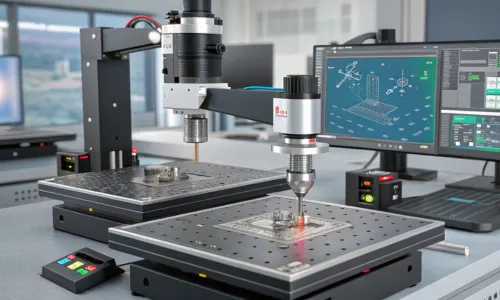
Designed for high-precision, variable-speed motion control, servo-driven SPMs allow accurate part positioning and dynamic speed adjustments.
Used in assembly, packaging, and testing machines, these systems provide smooth, programmable movement with repeat accuracy.
- Advanced torque and speed control
- Ideal for fine-tolerance manufacturing
- Reduces mechanical wear and improves response time
Robotic-Integrated SPMs
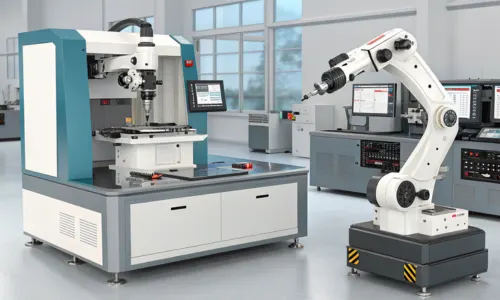
Combining robotics with SPMs results in fully automated manufacturing cells that can pick, place, weld, assemble, or inspect components without human intervention.
Robotic integration enhances flexibility and adaptability, especially in multi-product manufacturing environments.
- High-speed, high-precision handling
- Compatible with collaborative and industrial robots
- Increases uptime and throughput
Vision-Assisted SPM Automation
Vision-assisted SPMs employ industrial cameras and AI-based software to ensure quality control, part orientation, and error detection in real-time.
These systems are widely used in inspection, alignment, and sorting applications where precision and traceability are vital.
- Real-time visual feedback for process accuracy
- Integrated image-based quality assurance
- Reduces manual inspection errors


Hybrid Automation Systems
Hybrid SPMs combine pneumatic, hydraulic, and servo control systems within a single machine architecture to handle complex, heavy-duty tasks.
They offer superior control flexibility for industries like automotive, forging, and metal fabrication, where both power and precision are critical.
- Unified PLC-based control for all motions
- Scalable to different production loads
- Robust structure with programmable flexibility
Our Expertise in Automation Machine Manufacturing
At Synergy Automatics, we don’t just automate — we engineer performance.Our automation solutions are built on precision design, proven control logic, and hands-on industry experience.
Our Capabilities
Custom Design & Simulation: 3D modeling and motion path optimization.
Control System Engineering: PLC, HMI, and servo configuration.
In-House Panel Building: Wiring, testing, and quality validation.
Integration & Commissioning: Mechanical, electrical, and software synchronization.
After-Sales Service: Remote diagnostics, AMC, and upgrade support.
As one of India’s reliable Automation Machine Manufacturers, we supply turnkey SPM automation systems to automotive, electronics, and process industries across Chennai, Coimbatore, Pune, and Bangalore.
Key Components Used in SPM Automation
| Component | Function |
|---|---|
| PLC & HMI | Brain of the automation system — executes logic and provides operator interface. |
| Servo Motors & Drives | Deliver precision control over motion, torque, and speed. |
| Sensors & Encoders | Provide feedback for real-time adjustments and accuracy. |
| Vision Systems | Capture product data for inspection or sorting. |
| Robotics Interface | Enables autonomous pick-and-place or palletizing. |
| Safety Relays & Barriers | Protect operators and maintain fault-free operation. |
Our Process for Delivering Automated SPMs
Requirement Study & Concept Design
Analyze workflow, process, and space constraints.
Automation Logic Development & Simulation
Program PLCs, HMIs, and servo axes for functionality and speed.
Mechanical & Electrical Integration
Combine motion, structure, and controls into one robust unit.
Panel Wiring, Programming & Testing
Validate performance and safety before dispatch.
On-Site Installation & Commissioning
Deploy, align, and fine-tune on the production floor.
Training, AMC & Remote Support
Ensure smooth operation with ongoing maintenance support.
Benefits of SPM Automation
SPM automation, manufacturers gain the competitive edge of Industry 4.0 — real-time insights, adaptive control, and optimized production flow.
Higher Throughput: Continuous, fast, and synchronized operations boost output.
Consistent Quality: Servo precision and PLC control eliminate variation.
Reduced Labour Dependency: Automation lowers manpower costs and fatigue.
Improved Safety: Smart sensors and interlocks prevent accidents.
Lower Maintenance: Fewer manual adjustments mean longer machine life.
Scalable & Upgradable: Easily integrate future robotics or IoT modules.
Faster ROI: Automation minimizes downtime and maximizes resource utilization.

Industries We Serve
Our automation systems are trusted across a wide industrial spectrum:
Automotive & Engineering – Assembly, welding, and testing automation
Electronics & Electrical – PCB soldering and quality inspection
FMCG & Packaging – Filling, labeling, and sealing lines
Pharmaceuticals – Inspection and packaging automation
Metalworking & Foundry – Precision machining and finishing
Food & Beverage – Product handling and processing
From small-scale assembly to heavy engineering, Synergy Automatics provides automation excellence tailored to each sector.
Applications of Automated SPMs
Automation in special purpose machines enhances speed, consistency, and accuracy across a wide range of industrial operations.
Synergy Automatics provides application-specific automation designed for the following key areas:
Assembly & Testing: Automated torque, press-fit, and leak-testing stations.
Process Automation: Laser cutting, welding, and spraying operations.
Inspection & Quality Control: Vision-based inspection and defect detection.
Packaging & End-of-Line Systems: Labeling, sorting, and carton handling.
With SPM automation, manufacturers gain the competitive edge of Industry 4.0 — real-time insights, adaptive control, and optimized production flow.
Why Choose Synergy Automatics
15+ Years of Expertise in industrial and special purpose machine automation.
In-House Design & Manufacturing ensures quality and faster delivery.
Certified Components from Siemens, Delta, and Mitsubishi for long-term durability.
Complete Support — installation, training, and AMC services across India.
Custom-Engineered Solutions designed for precision, speed, and reliability.
PLC, Servo & Robotic Integration for seamless automation performance.
Proven ROI — boost productivity, reduce downtime, and ensure consistent output.
Frequently Asked Questions
1. What is meant by Special Purpose Machine Automation?
Special Purpose Machine Automation refers to the integration of PLCs, servo systems, and robotics into machines designed for a specific manufacturing process. It improves precision, reduces manual effort, and increases productivity.
2. How does SPM automation improve production efficiency?
Automated SPMs streamline multi-stage operations, reduce downtime, and enable faster cycle times. They also maintain consistent quality by eliminating human error and optimizing motion control.
3. What are the main components of an automated SPM system?
An automated SPM includes PLC controllers, servo motors, HMI panels, sensors, encoders, and safety interlocks — all working together to ensure smooth, precise, and safe operation.
4. Can existing manual special purpose machines be upgraded to automation?
Yes. Existing manual or semi-automatic SPMs can be retrofitted with PLCs, servo drives, and vision sensors to enhance speed, accuracy, and monitoring without needing a full replacement.
5. What are the benefits of automating special purpose machines?
Key benefits include higher throughput, reduced manpower costs, improved accuracy, enhanced safety, real-time monitoring, and faster return on investment.
6. Which industries commonly use automated SPM systems?
Industries such as automotive, electronics, FMCG, pharmaceuticals, packaging, and metal fabrication use automated SPMs for assembly, testing, inspection, and material handling operations.
7. What technologies are used in modern SPM automation?
Modern SPM automation relies on PLCs, servo drives, robotics, HMI control, sensors, and vision systems from leading brands like Siemens, Mitsubishi, Delta, and Omron.
8. How does robotic integration enhance SPM performance?
Robotic integration improves flexibility and speed, allowing SPMs to handle pick-and-place, welding, or inspection tasks with greater accuracy and minimal human assistance.
9. What is the ROI timeline for an automated special purpose machine?
Typically, ROI is achieved within 12–24 months depending on process complexity, production volume, and efficiency gains — significantly faster than traditional systems.
10. Does SPM automation support Industry 4.0 integration?
Yes. Modern SPM automation systems support IoT, data logging, and remote monitoring, aligning with Industry 4.0 standards for smart, connected manufacturing.