AMR Solutions for Warehousing & Logistics Automation
Synergy Automatics provides AMR solutions for warehousing and logistics automation to improve goods movement, pallet transport, inventory coordination, system integration, and fleet control. Our AMR-based solutions help reduce manual dependency, improve safety, minimise movement delays, and support faster warehouse operations.
Warehouses and logistics centres require continuous material movement between storage, picking, packing, replenishment, staging, and dispatch areas. When this movement is handled manually through workers, trolleys, pallet jacks, or forklifts, it can lead to delays, fatigue, safety risks, picking errors, traffic congestion, and higher labour costs.
Autonomous Mobile Robots help solve these challenges by automating repetitive goods movement, heavy load transport, task dispatch, and multi-robot coordination. Synergy Automatics designs AMR solutions based on warehouse routes, load type, aisle space, order volume, system requirements, and business workflow.
Warehousing & Logistics Challenges
- Workers spend long hours walking across warehouse zones for material pickup and delivery.
- Manual goods movement increases fatigue, injury risk, and employee turnover.
- Picking and movement errors cause mis-picks, wrong transfers, returns, and rework.
- Forklift and pedestrian movement in shared aisles increases safety risks.
- Aisle congestion during peak replenishment slows down warehouse operations.
- Inventory records and physical stock movement may not match correctly.
- Manual task dispatch creates delays between order receipt and fulfilment start.
- Multiple robot systems or dashboards can create poor visibility and traffic conflicts.
AMR Applications for Warehousing & Logistics
Autonomous Goods Movement
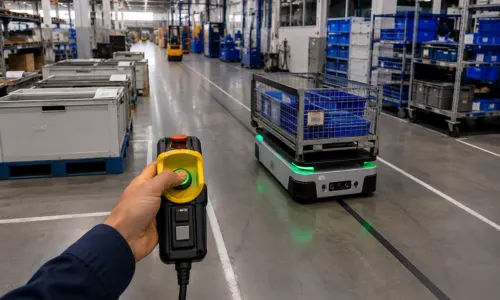
AMRs automate the movement of bins, boxes, totes, trays, cartons, and materials between warehouse pickup and drop points. This reduces worker walking, improves picking and packing flow, and helps speed up internal goods movement.
Multi-Vendor Fleet Orchestration
Fleet orchestration helps manage multiple AMRs or different robot systems through a central control platform. It improves traffic control, task allocation, robot visibility, and reduces dependency on separate dashboards.
WMS / ERP System Integration
AMR systems can be connected with WMS, ERP, or warehouse operation software to create movement tasks automatically. This improves stock movement visibility, reduces manual task assignment delays, and helps managers track what is moving, delayed, or completed.
Heavy Pallet & Bulk Transport
Heavy-duty AMR solutions help move pallets and bulk loads between storage, replenishment, staging, and dispatch areas. This reduces forklift dependency, improves aisle safety, and supports consistent pallet movement during peak operations.
Benefits of Warehousing & Logistics AMR
Reduces manual walking and repetitive goods movement.
Improves warehouse productivity and order movement speed.
Reduces worker fatigue, manual handling risk, and injury possibilities.
Reduces forklift congestion in shared warehouse aisles.
Minimises picking errors, wrong transfers, and material misplacement.
Improves pallet movement and replenishment consistency.
Supports faster picking, packing, staging, and dispatch operations.
Reduces dependency on additional manpower during peak operations.
Supports scalable warehouse automation for future growth.
Why Choose Synergy Automatics
Synergy Automatics provides application-focused AMR solutions designed for real warehouse and logistics movement challenges.
We support AMR planning for storage, picking, packing, replenishment, staging, returns, and dispatch operations.
We focus on on-time project delivery with proper planning, installation, testing, and support.
Our solutions are designed to fit your existing operation and support future warehouse automation expansion.
We study your layout, aisle width, goods flow, load type, travel distance, and daily operation volume before planning the solution.
We provide quality materials and reliable automation components to support long-term performance.
We offer code customization and workflow customization based on your warehouse process and system requirements.
FAQ for AMR Warehousing & Logistics
1. What is an AMR robot used for in a warehouse?
An AMR robot is used to move goods, bins, cartons, pallets, and materials inside a warehouse without continuous manual handling.
2. How much does a warehouse AMR system cost?
The cost depends on load capacity, number of robots, travel distance, software integration, safety requirements, and customization needs.
3. Is AMR better than conveyor systems?
AMR is better when the warehouse needs flexible movement routes, layout changes, and multiple pickup and drop points without fixed conveyor installation.
4. Can AMR work in a small warehouse?ions?
Can AMR work in a small warehouse?
5. How much space is required for AMR movement?
The required space depends on robot size, load type, turning radius, aisle width, traffic flow, and warehouse layout.
6. Can AMR replace forklift operations?
AMR can reduce forklift dependency for repetitive pallet and material movement, but some heavy loading or special handling tasks may still need forklifts.
7. Is AMR safe around workers?
Yes, AMRs are designed with sensors and navigation systems to detect people, racks, and obstacles during movement.
8. Can AMR move pallets?
Yes, pallet-moving AMRs can transport pallets and bulk loads based on the required load capacity and warehouse route condition.
9. How long does it take to install an AMR system?
Installation time depends on site study, route planning, robot configuration, software setup, testing, and any required system integration.
10. Can AMR connect with warehouse software?
Yes, AMR systems can connect with WMS, ERP, or other warehouse software for automatic task creation, tracking, and operation visibility.
11. What maintenance is required for AMR robots?
AMR maintenance usually includes battery checks, sensor cleaning, wheel inspection, software updates, safety checks, and regular performance testing.
12. How do I choose the right AMR for my warehouse?
The right AMR depends on your load weight, material type, aisle space, travel distance, pickup and drop points, shift volume, and integration requirements.
13. Can AMR reduce warehouse labour cost?
Yes, AMR can reduce labour dependency for repetitive movement tasks and help workers focus on picking, packing, checking, and dispatch work.
14. Does AMR need floor marking or track installation?
Most AMRs do not need fixed tracks or major floor marking like traditional guided vehicles, but proper route mapping and safety planning are required.