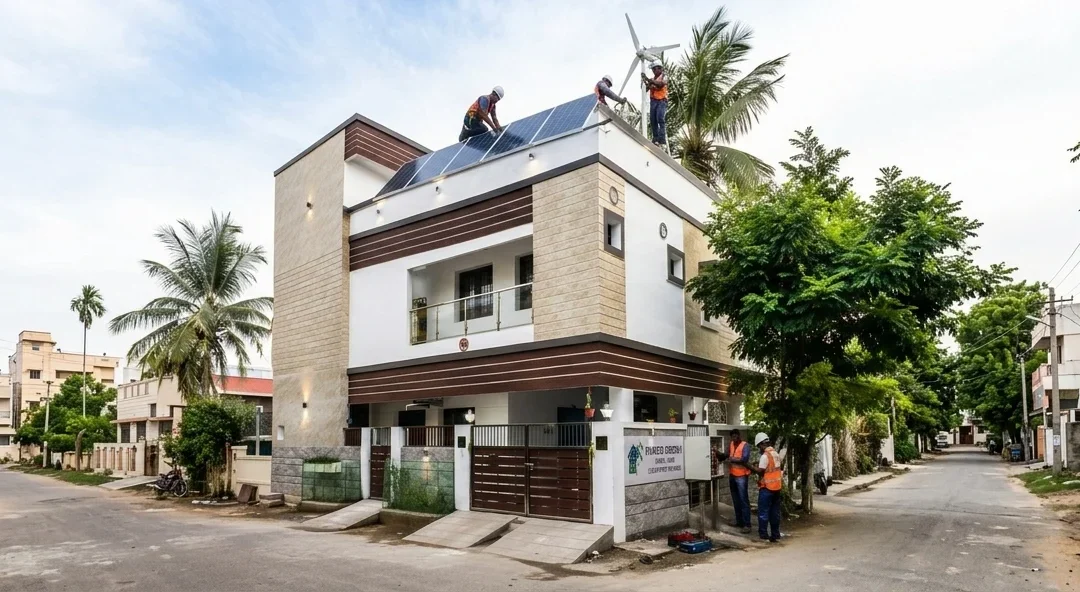
The most common installation challenges in residential hybrid projects are limited roof space, poor wind conditions, battery placement issues, inverter and controller matching, house-side electrical integration, safety planning, and future service access.
A residential hybrid system is more complex than a basic solar setup because it combines solar panels, a wind turbine, batteries, an inverter, controllers, protections, and home electrical integration in one project. When these parts are planned properly, the system can give better backup, improved charging continuity, and more balanced renewable energy support. But if the site, layout, or system coordination is weak, installation problems can appear quickly.
Why Residential Hybrid Projects Are More Challenging
A residential hybrid project includes more variables than a simple rooftop solar installation.
It may involve:
- Solar Array
- Residential Wind Turbine
- Battery Bank
- Hybrid Inverter And Controller
- Monitoring And Safety Provisions
- Safe Connection To The Home Panel
Because of this, the installer must plan:
- Roof Space And Solar Layout
- Wind Quality And Turbine Placement
- Battery Location And Ventilation
- Inverter And Controller Compatibility
- Protections And Wiring
- Access For Future Service
That is why hybrid projects need more careful planning from the beginning.
Main Installation Challenges to Check First
Before installation starts, these are the main challenges to check:
- Is there enough usable roof space for solar?
- Is wind actually useful at the property?
- Is the structure suitable for turbine mounting?
- Is there safe battery space with ventilation?
- Are the supported loads clearly defined?
- Are inverter and controller choices matched properly?
- Is the home electrical panel ready for clean integration?
- Is there safe access for future maintenance?
If these questions are answered early, many later problems can be avoided.
1. Limited Roof Space or Poor Solar Layout
One of the first challenges is finding enough usable space for the solar part of the system.
In many homes, problems happen because:
- Roof Area Is Smaller Than Expected
- Water Tanks Or Walls Block Usable Panel Space
- Shading Reduces Solar Performance
- Roof Direction Is Not Ideal For The Planned Size
Why this matters
If the solar layout is poor, the full hybrid balance changes. The wind and battery parts may then be expected to do more than originally planned.
Practical solution
Check the actual usable roof area early. Solar size should be based on real space and real layout, not only on the desired kW.
2. Poor Wind Conditions at the House
This is one of the biggest challenges in residential hybrid projects.
A home may look suitable for wind on paper, but in real use the site may have:
- Nearby Buildings Blocking Airflow
- Trees Creating Turbulence
- Low Mounting Height
- Poor Wind Quality Around The House
Why this matters
A wind turbine installed in poor airflow may add very little value, even if the equipment itself is good.
Practical solution
Review wind feasibility honestly before deciding the wind portion of the project.
Simple example
A house may have good roof space for solar but poor airflow because surrounding buildings block wind movement. In that case, the hybrid system may need a different balance than originally planned.
3. Structural Challenges for Wind Turbine Mounting
A wind turbine adds installation difficulty beyond normal rooftop solar.
Common structural challenges include:
- Weak Mounting Points
- Roof Structures Not Suited For Turbine Vibration
- Limited Clearance
- Difficulty Achieving Safe Height
- Lack Of Service Space
Why this matters
Unlike solar panels, a wind turbine is a moving component. Its mounting must handle dynamic load, not just static weight.
Practical solution
Plan the turbine side with structural review, vibration awareness, and safe service access from the start.
4. Finding Safe and Practical Battery Space
Battery placement is another common residential challenge.
Real project issues may include:
- Not Enough Indoor Space
- Poor Ventilation
- Difficult Cable Routing
- Placement Too Close To Unsuitable Areas
- No Proper Access For Inspection And Future Maintenance
Why this matters
Poor battery placement can create long-term safety, maintenance, and usability problems.
Practical solution
Decide battery location early, not after the rest of the system is already fixed.
5. Mismatch Between Load Expectation and Installed Capacity
Many residential projects face trouble because the homeowner expects more than the designed system can actually support.
This usually happens when:
- The Full House Is Expected To Run During Outages
- Actual Daily Use Is Underestimated
- Essential Loads Are Not Identified Clearly
- Wind Contribution Is Assumed Without Site Review
Why this matters
Even a technically correct system may feel disappointing if the expected loads and backup hours were never defined properly.
Practical solution
Decide supported loads and backup goals clearly before installation begins.
6. Integrating Solar, Wind, Battery, and Inverter as One System
A hybrid project works only when all parts are treated as one coordinated power system.
Installation problems can happen when:
- Solar And Wind Are Treated Like Separate Mini-projects
- The Inverter Or Controller Is Not Selected Properly
- Battery Voltage Planning Is Weak
- The House-side Power Flow Is Not Designed Clearly
Why this matters
Even good individual components can underperform if the system architecture is poor.
Practical solution
Plan the full electrical path as one system from the beginning.
7. Inverter and Controller Compatibility Challenges
The inverter and controller are central to a residential hybrid project.
Common issues include:
- Wrong Inverter Size
- Weak Compatibility Between Sources And Battery Bank
- Poor DC Voltage Planning
- No Room For Future Expansion
Why this matters
If these parts are not matched correctly, the system may not behave as expected under real household conditions.
Practical solution
Choose inverter and controller only after load study, source sizing, and battery planning are clear.
8. House-Side Electrical Integration Problems
Another common challenge is connecting the hybrid system safely to the home distribution panel.
Typical house-side issues include:
- Unclear Separation Of Essential Circuits
- Poor Routing To Supported Loads
- Weak Protection Coordination
- Difficulty In Handling Backup Logic Cleanly
Why this matters
A system may generate and store power well, but if delivery to home circuits is poorly planned, the homeowner will still face usability problems.
Practical solution
Review the house electrical side early, especially if selected circuits must stay ON during outages.
9. Protection and Safety Coordination
Safety is a major challenge when attention is focused only on generation size.
Important safety-related installation issues may include:
- Isolators Not Planned Properly
- Poor Earthing Arrangement
- Weak Wiring Protection
- Limited Access To Protection Devices
- Unclear Safe Integration With The Home Panel
Why this matters
A hybrid system includes more than one power source and often battery storage, so protection planning is essential for safe long-term use.
Practical solution
Treat safety scope as part of the original project plan, not as an extra item to add later.
10. Service Access Is Often Overlooked
Many installations focus only on fitting equipment wherever space is available. Later, maintenance becomes difficult.
Common service-access problems include:
- Turbine Placed Where Inspection Is Difficult
- Battery Area Too Cramped
- Inverter Mounted In An Awkward Location
- Protections Not Easily Reachable
Why this matters
A residential hybrid system should remain easy to inspect and maintain over time.
Practical solution
Install every major component with future service work in mind.
11. Balancing Budget With Practical Scope
Budget is another common challenge in residential hybrid projects.
Some homeowners want:
- Strong Backup
- High Solar Capacity
- Wind Support
- Large Batteries
- Premium Safety Provisions
- Future-ready Expansion
all within a limited budget.
Why this matters
If the budget and the real project scope are not aligned, compromises may happen in the wrong places.
Practical solution
Build the project around actual priorities: essential loads, realistic backup, safe installation, and proper integration.
12. Expansion Planning Can Be Missed
Some systems are built only for day-one needs without considering future changes.
That may create problems later if the homeowner wants:
- More battery capacity
- More solar support
- Wider load support
- Improved monitoring
Why this matters
Without expansion planning, later upgrades may require more redesign than necessary.
Practical solution
Even if the full system is not installed at once, the design should allow practical future growth.
13. Keeping the System Balanced Over Time
A hybrid project is not successful only because it works on commissioning day. It should remain stable and useful over time.
That means the system should continue to provide:
- Better charging continuity
- Lower grid dependence for key loads
- Stable backup support
- Balanced day-to-day performance
Why this matters
Installation challenges are not only about physical fitting. They are also about creating a system that stays practical under changing daily and seasonal conditions.
Practical solution
Focus on long-term balance, not just day-one installation completion.
FAQs
1. What is the most common challenge in residential hybrid installation?
One common challenge is trying to fit solar, wind, battery, and inverter into a home without fully checking site conditions and supported loads first.
2. Why is wind a bigger challenge in residential hybrid projects?
Because wind performance depends heavily on airflow quality, mounting height, surrounding obstructions, and structural suitability.
3. Can battery placement affect the success of the project?
Yes. Poor battery placement can create ventilation, maintenance, and serviceability problems.
4. Why is service access important in a home hybrid installation?
Because the system must be easy to inspect and maintain over time, especially for the turbine, inverter, protections, and battery bank.
5. Do installation challenges mean hybrid systems are not suitable for homes?
No. They simply mean the system needs proper planning and site-specific design.
6. Why is integration a challenge in hybrid projects?
Because solar, wind, battery, inverter, and home circuits must all work together as one coordinated electrical system.
7. How can homeowners reduce installation problems?
By starting with load study, site assessment, realistic wind review, battery planning, safe installation design, and correct sizing.