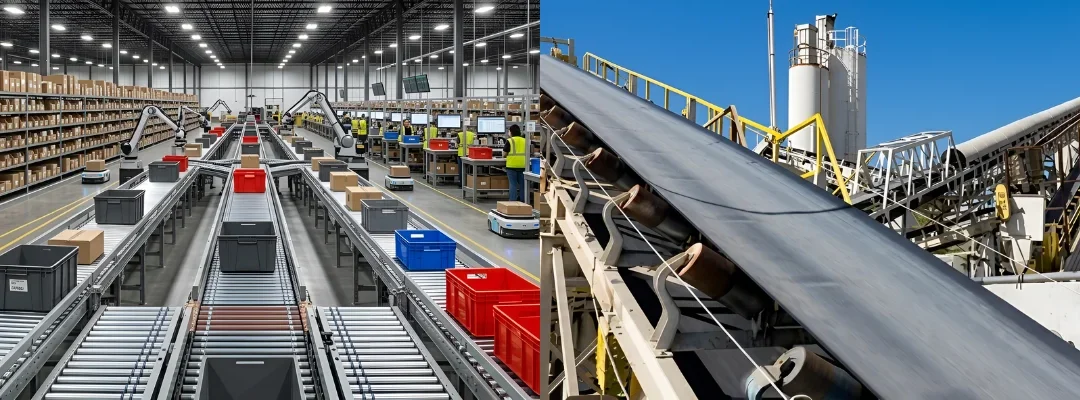
look at the key design considerations when you’re specifying a conveyor for indoor vs. outdoor service
| Aspect | Indoor Conveyors | Outdoor Conveyors |
|---|---|---|
| Environmental Exposure | • Controlled temperature/humidity | • Full exposure to sun, rain, wind, snow |
| • Minimal exposure to dust and rain | • Wide temperature swings | |
| • UV degradation risks | ||
| Structural Materials | • Standard steel (painted or powder-coated) | • Galvanized or 316 stainless steel |
| • Mild stainless steel in wash-down zones | • UV-stabilized plastics and seals | |
| Protection & Enclosure | • Usually open-frame; guards per safety code | • Must include full weather covers or enclosures |
| • Sealed junction boxes and cable trays (IP66+) | ||
| Foundations & Supports | • Mounted to existing floor or mezzanine | • Engineered footings or piers to resist frost heave |
| • Light steel or modular frames | • Heavy-duty supports to withstand wind loads | |
| Drive & Controls | • Standard AC drives in protected control panels | • Drives in weatherproof enclosures (NEMA 4/4X) |
| • 24 V controls often in pull-out cabinets | • Heaters or coolers inside enclosures for extreme temps | |
| • Remote-mountable operator stations | ||
| Material Handling | • Product flow largely uninterrupted by weather | • Must guard against wind-blown debris, water ingress into product |
| • Convey through ducts or cleanrooms | • Incorporate drip pans, grate-type cleats, or wash-off zones | |
| Thermal Expansion | • Minor spans; standard belt-tracking adjustments | • Long runs require expansion joints and take-up designs to absorb length changes |
| Maintenance Access | • Easy overhead or side access | • Platforms, catwalks, fall protection for roof- or elevated conveyors |
| • Minimal PPE required | • Weather-rated ladders and handrails | |
| Safety & Compliance | • Guards per ISO 13857 or OSHA | • Additional lightning-protection grounding |
| • Standard emergency stops | • Slip-resistant walkway surfaces if platformed | |
| • Local building codes for outdoor structures | ||
| Power & Utilities | • Wired through building infrastructure | • UV-resistant cabling |
| • Cable trays inside walls | • Conduits or trenching to protect feed from elements | |
| Corrosion Control | • Occasional clean-and-paint cycle | • Regular anti-corrosion coatings or sacrificial anodes |
| • Routine inspection for rust and seal integrity |
Top Design Tips
- Material Compatibility
Outdoor belts & components should be rated for UV and wide temperature ranges. - Ingress Protection (IP) Rating
Specify IP66+ for drives, sensors, and junctions used outdoors. - Drainage & Wash-Down
Outdoor conveyors need drip rails, sloped frames, and easy-drain pans to avoid water pooling. - Environmental Controls
In very cold climates, include belt-heaters or enclosures; in hot climates, shade panels or cooling fans. - Modular Expansion
Design in pre-engineered expansion joints and adjustable supports to accommodate seasonal shifts. - Maintenance Planning
Factor in more frequent inspections and protective-gear requirements for outdoor personnel.
By tailoring materials, enclosures, foundations, and protective systems to the operating environment, you’ll ensure reliability, safety, and longevity—whether it’s in a climate-controlled hall or out under the open sky.