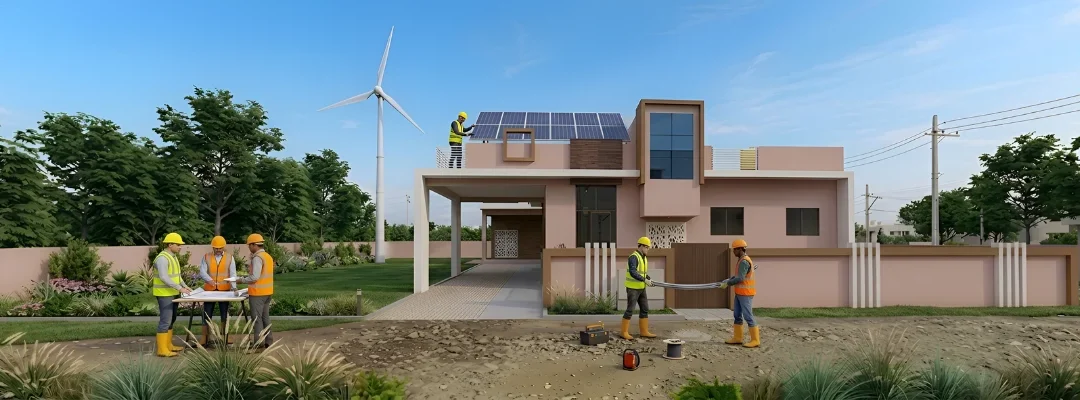
Installing a solar wind hybrid system for your house is not just about adding solar panels and a wind turbine. Before installation, you need to check your power usage, backup requirement, roof suitability, wind conditions, battery planning, inverter compatibility, and electrical safety.
A hybrid system works best when it is planned as one complete energy system. It combines solar generation, wind generation, battery storage, inverter control, and electrical protection in one coordinated setup. When designed properly, it can support essential loads during power cuts, improve energy continuity, and reduce dependence on grid electricity for selected circuits. But if it is installed without proper planning, the system may not perform the way you expect.
Understand What a Solar Wind Hybrid System Really Is
The first thing to know is that a solar wind hybrid system is one integrated power system.
It is not just a solar setup with a wind turbine added later. In a proper home hybrid system:
- Solar Panels Generate Power During Daylight
- The Wind Turbine Contributes When There Is Usable Airflow
- The Controller Manages Both Sources
- Batteries Store Energy If Backup Is Required
- The Inverter Supplies AC Power To The House Circuits
This matters because system performance depends on how well all parts work together.
Check If Your House Is Actually Suitable
Not every house is automatically suitable for a solar wind hybrid system.
Before installation, check:
- Does The House Have Good Solar Exposure?
- Is There Enough Space For Panels?
- Is The Roof Structurally Safe?
- Is There Usable Airflow For A Wind Turbine?
- Are There Nearby Buildings Or Trees Causing Turbulence?
- Is There Safe Space For Batteries And Electrical Equipment?
- Is There Enough Access For Maintenance?
A hybrid system works well only when the site supports it.
Start With Load and Backup Requirement
One of the biggest mistakes is choosing system capacity before understanding the actual need.
Start by checking:
- Daily Electricity Consumption
- Essential Loads
- Peak Usage Times
- Expected Backup Hours
This helps you decide what the system really needs to support.
For example, some houses may only want backup for:
- Lights
- Fans
- Router
- Refrigerator
- Cctv
Others may want support for more loads such as a washing machine, office equipment, or additional appliances.
The system size depends on these priorities.
Do Not Assume Bigger Capacity Is Always Better
Many people think a bigger system is always better. That is not true.
- A System That Is Too Small May Not Meet Your Requirement
- A System That Is Too Large May Increase Cost Without Real Need
A better system is one that is correctly sized, not simply oversized.
Solar Sizing Must Match the House
Solar is usually the main daytime power source in a hybrid system. But solar sizing should be based on the actual house, not on guesswork.
Important points include:
- Roof Direction
- Shading
- Available Panel Space
- Daytime Load
- Expected Solar Contribution
You should not choose solar capacity just by copying another property or selecting only by budget.
Wind Turbine Selection Depends on Real Airflow
A wind turbine should never be selected only by brochure rating.
Before choosing a turbine, check:
- Actual Wind Conditions In The Area
- Wind Quality At Turbine Height
- Nearby Obstacles
- Turbulence From Buildings And Trees
- Safe Mounting Height
This is very important because wind performance is highly site-dependent. If the property does not have workable airflow, the turbine may not contribute meaningfully.
Choose the Right System Combination
A hybrid system is not decided by solar size alone or wind size alone. The full combination must match the house.
This includes:
- House Load
- Backup Hours
- Roof Space
- Wind Suitability
- Battery Size
- Inverter Compatibility
A balanced system performs better than one built around random component sizes.
Battery Planning Is Very Important
Many homeowners focus on panels and turbines but forget that battery planning is just as important, especially if backup is one of the main goals.
Before installation, think about:
- How Many Hours Of Backup Are Needed
- Which Loads Must Stay On
- Battery Voltage And Capacity
- Battery Placement
- Ventilation And Safety
- Future Expansion
Without proper battery planning, even a good generation system may not give the backup support you expect.
Inverter and Controller Matching Matter
The inverter and controller are not small details. They are a major part of the full system.
They help manage:
- Solar Input
- Wind Input
- Charging Control
- Battery Use
- Power Delivery To House Circuits
If these parts are not matched properly, system performance and reliability can suffer.
Decide What the System Will Support
Before installation, be clear about what the hybrid system is meant to do.
Is it for:
- Essential-load Backup Only?
- Partial House Support?
- A Larger Share Of Total House Consumption?
This is important because homeowners should not assume the system will automatically run the full house unless it is designed for that purpose.
Mounting and Structural Safety Matter
Installation safety is a major part of system performance.
For solar, check:
- Essential-load Backup Only?
- Partial House Support?
- A Larger Share Of Total House Consumption?
For wind, check:
- Structural Support
- Vibration Control
- Safe Tower Or Mounting Height
- Airflow Exposure
- Service Access
These are not minor details. They directly affect safety and long-term performance.
Electrical Protection Is Essential
A solar wind hybrid system should never be installed without proper electrical protection.
Important protection points include:
- Proper Wiring
- Earthing
- Isolation
- Mcbs Or Similar Protections
- Surge Protection Where Needed
- Safe Battery Connections
These protections are important for both equipment safety and household safety.
Think About Monitoring and Service Access
A good installation should not only work on day one. It should also be easy to check and maintain over time.
Before installation, consider:
- Generation Monitoring
- Battery Status Visibility
- Inverter Display Or App Monitoring
- Maintenance Access
- Space For Future Inspection Or Replacement
A system that is hard to service may become inconvenient later.
Keep Practical Expectations
A hybrid system is a smarter and more flexible setup, but it is not magic.
A practical expectation is this:
- Solar supports most daytime generation
- Wind may contribute when sunlight is low, if airflow is suitable
- Batteries help during outages
- Essential loads can stay ON longer with correct backup planning
The system should be seen as a well-planned energy solution, not as unlimited power in every condition.
Think About Future Expansion
Before installation, think about what you may want later.
For example:
- More battery capacity
- More solar panels
- Inverter upgrade
- Better monitoring system
Planning for expansion early can reduce future rework and cost.
Choose Engineering Quality, Not Only Price
The final thing to know is this: the cheapest installation is not always the best one.
A good solar wind hybrid installation should be based on:
- Load Analysis
- Site Suitability
- Airflow Study
- Correct Sizing
- Equipment Compatibility
- Safety Protection
- Clean Installation Quality
That is what leads to better long-term performance and value.
FAQs
1. What should I check before installing a solar wind hybrid system for your house?
Check your daily load, backup need, roof condition, wind suitability, battery space, and electrical safety requirements.
2. Is every house suitable for a solar wind hybrid system?
No. Suitability depends on solar exposure, airflow, structure, and installation space.
3. Why is load calculation important before installation?
Because the system should be sized based on actual energy use and essential loads, not general estimates.
4. Can I install a wind turbine on any rooftop house?
Not always. Wind performance and safety depend on airflow quality, mounting design, structure, and surrounding obstacles.
5. Is battery planning necessary in a hybrid home system?
Yes. It is especially important if you want backup during power cuts.
6. Why do inverter and controller matching matter?
Because they manage solar input, wind input, charging, battery use, and power delivery to the house.
7. What is the biggest mistake before installation?
A common mistake is choosing capacity without proper load study, site assessment, and integration planning.