Industrial IoT Applications for Underground & Coal Mines
A practical pillar guide to connected ventilation, gas, worker safety, mobile equipment, material flow, ground control, utilities and control-room intelligence.
From isolated instruments to actionable mine intelligence
Underground operations generate critical information across atmosphere, airflow, people, machines, conveyors, ground conditions and utilities. An engineered IoT layer can collect this information at the edge, preserve local protection, and deliver usable trends, alarms and reports to authorised teams.
Sense
Capture physical conditions through mine-suitable field instruments and equipment interfaces.
Connect
Move timestamped data through resilient wired or wireless underground communications.
Understand
Apply alarm rules, trends, health checks, analytics and contextual operational data.
Act
Support maintenance, response and optimisation while approved local controls remain primary.
Continuous airflow needs continuous visibility
Start with the core ventilation-fan pages, then connect air quality, gas and ventilation-on-demand applications.

IoT Ventilation Fan Monitoring
Continuously monitor auxiliary and main ventilation fans to verify airflow availability, identify mechanical deterioration and support energy-efficient operation.
Explore solution ›
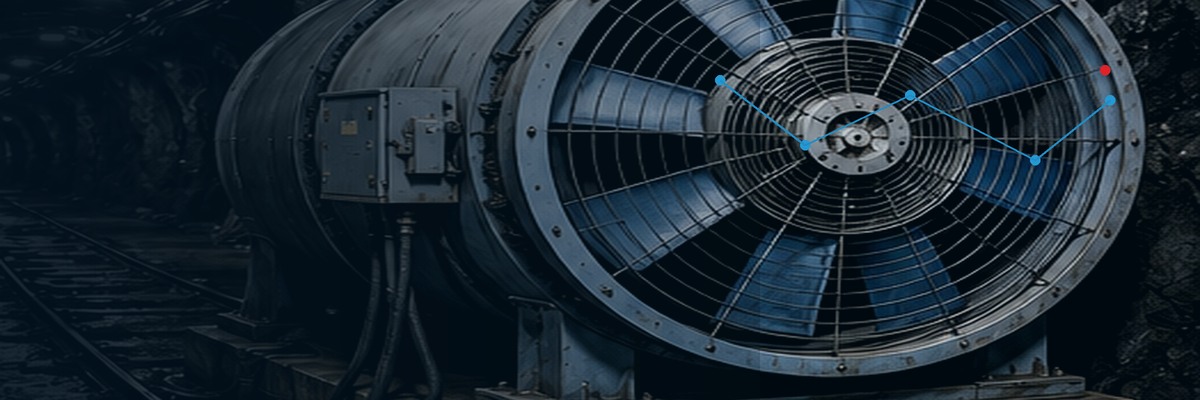
Online Monitoring of Ventilation Fans in Coal Mines
A coal-mine-focused monitoring solution for main, booster and auxiliary fans, combining airflow, pressure, motor and condition data in one control-room view.
Explore solution ›
Online Monitoring of Ventilation Fans in Underground Mines
Real-time health and performance monitoring for underground mine ventilation fans, with secure edge acquisition, alarms and browser-based dashboards.
Explore solution ›
52 IoT applications for underground and coal mines
Each application guide covers monitored points, typical devices, connectivity, alarm logic, architecture, deployment locations, benefits and implementation considerations.
Ventilation, Gas & Environmental Safety
Monitor underground atmosphere, airflow and fire risks continuously.
People, Access & Emergency Safety
Improve situational awareness around personnel, vehicles and emergency response.
Equipment, Fleet & Maintenance Intelligence
Connect mobile and fixed assets for reliability, utilisation and safer operation.
Conveyors, Production & Material Flow
Track coal movement, production constraints and material-handling risks.
Water, Ground Control & Geotechnical
Detect water, roof, strata and seismic conditions before they disrupt operations.
Energy, Lighting & Utilities
Measure and optimise power, lighting, compressed air and pipelines.
Connectivity, Control & Digital Mine
Build the communications, analytics and control-room layer for a connected mine.
A layered path from the mine to the control room
The exact technologies vary by mine, but robust deployments separate field measurement, local control, edge acquisition, transport and applications.
Field layer
Gas, airflow, condition, location, energy and geotechnical instruments.
Local control
PLCs, protection relays, safety systems, machine controllers and local alarms.
Edge layer
Protocol conversion, buffering, timestamping, health checks and local analytics.
Mine network
Fibre, industrial Ethernet, leaky-feeder, Wi-Fi, LoRaWAN or private cellular.
Application layer
SCADA, dashboards, historians, notifications, reports and integration APIs.
Scale from a defined use case—not from disconnected sensors
Risk and value definition
Choose the operational decision, owner, response workflow and measurable outcome.
Pilot and validate
Instrument a representative area, establish baselines and prove data quality.
Integrate and standardise
Connect SCADA, maintenance, mine plans and reporting through governed interfaces.
Scale and improve
Roll out repeatable designs, monitor system health and refine alarms and analytics.
IoT dashboards improve visibility, but they do not replace certified gas systems, protection relays, emergency stops, statutory inspections, approved trigger-action-response plans or competent operational authority.
Build a connected-mine roadmap around your priorities
Discuss field instrumentation, edge connectivity, dashboards and integration with the Synergy Automatics team.
Engineering note: Instrument selection, hazardous-area certification, alarm limits, interlocks and network architecture must be validated against the mine risk assessment, applicable legislation, equipment approvals and site operating procedures.