Intelligent AMR Solutions
Synergy Automatics provides intelligent Autonomous Mobile Robot solutions for factories, warehouses, production plants and logistics facilities that need safer, faster and more flexible internal material movement.
Our AMR systems help automate the movement of raw materials, pallets, bins, trolleys, components, work-in-progress items and finished goods across your facility. With smart navigation, fleet control, safety sensors and system integration, AMRs help industries reduce manual handling and improve operational efficiency.
AMR solutions are ideal for modern industrial environments where material movement must be reliable, scalable and easy to manage without fixed tracks or major floor modifications. These Autonomous Mobile Robots are suitable for flexible factory and warehouse automation.
Smart Material Movement for Modern Industries
In many factories and warehouses, internal material movement still depends on manual labour, forklifts, trolleys and repeated human effort. This can create delays, safety risks, manpower dependency and inconsistent production flow.
Synergy Automatics helps industries shift to smart AMR-based automation for smoother movement between storage, production, assembly, packing and dispatch areas.
Our AMR solutions are designed to support flexible factory layouts, changing routes, multiple pickup points and safe movement around people and machines.
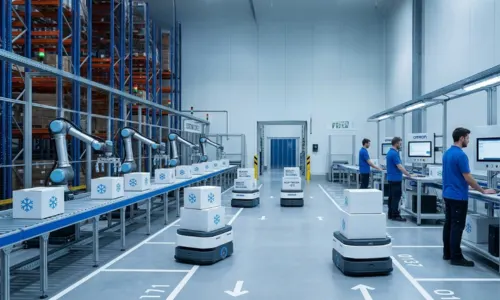
One Platform Complete Control
Synergy Automatics provides AMR solutions with a centralized control system to manage robot movement, task assignment, fleet operation, routes, battery status and performance monitoring.
Remote Monitoring
Remote monitoring helps track robot health, task status, alerts, battery level and performance data.
Pilot Control
Manual or remote pilot control can be used during testing, maintenance, special movement or supervised operation.
Battery Manager
Battery monitoring helps track robot power levels, charging status and operational availability.
Navigation and Multi-Mapping
AMRs use smart navigation and mapping to move safely through different routes, zones and facility layouts.
Fleet Management
Manage multiple AMRs from a single dashboard. Operators can assign tasks, monitor robot positions, manage traffic zones and control material flow across the shop floor.
Our AMR Product Range
Synergy Automatics offers different AMR configurations based on load capacity, material type, route condition and application requirement.
Compact Platform AMR
Compact platform AMRs are suitable for moving bins, trays, boxes, small components and medium loads across production and warehouse areas.
They are ideal for tight aisles, assembly line feeding, work-in-progress movement and flexible material transfer.
Heavy Platform AMR
Heavy platform AMRs are designed for larger loads and industrial material movement applications.
They are suitable for moving pallets, carts, heavy components, production materials and finished goods across manufacturing and warehouse facilities.
Towing AMR
Towing AMRs are designed to pull trolleys, carts and material carriers across factories, warehouses and logistics facilities.
They are suitable for businesses that already use carts or trolleys and want to automate the same movement process.
Lifting AMR
Lifting AMRs are used to lift and move pallets, racks, carts and custom load carriers.
They are suitable for applications where material needs to be picked from one point and placed at another without manual lifting.
One Robot Many Missions.
AMRs can be equipped with different top modules and attachments to support multiple material handling tasks.
Lifting Module
Lifting modules help pick up carts, pallets, racks or platforms from below and move them to the required location.
Towing Module
Towing modules connect with carts and trolleys for automated movement across the facility.
Shelf Carrier
Shelf carrier modules are useful for moving bins, totes, small parts, tools and production materials.
Conveyor Module
Conveyor modules automate loading and unloading between AMRs and conveyor lines.
Custom Pallet Handling Module
Custom pallet handling modules are designed for special pallet sizes, racks and unique material movement needs.
Tugging Module
Tugging modules support heavier trolley movement and multi-cart transport applications.
Cobot Base
A mobile cobot base allows collaborative robot arms to move between work areas for flexible automation.
Implementation Process
Facility Assessment
We study your factory or warehouse layout, material flow, load details, movement frequency, route distance, pickup points, drop points and handling challenges.
Application Selection
We identify the right AMR type based on payload, material size, route complexity, process requirement and operating environment.
AMR Configuration
The AMR is configured with the required top module, attachment, software settings, safety parameters and communication setup.
Integration
The AMR system is integrated with machines, conveyors, doors, lifts, field devices, ERP, WMS, MES, PLCs or other required systems.
Testing and Commissioning
The complete system is tested in actual working conditions to ensure safe movement, accurate routing, proper task execution and smooth material flow.
System Design
We design the AMR workflow, route logic, safety zones, charging method, integration points and fleet control requirement.
Training and Support
We provide operator training, maintenance guidance and technical support for reliable long-term operation.
Why Industries Choose AMR Automation
Reduced Manual Handling
AMRs reduce repetitive pushing, pulling, lifting and carrying of materials by workers.
Improved Productivity
Automated material movement helps workers focus on production, quality and value-added activities.
Better Workplace Safety
AMRs reduce risks related to manual handling, trolley movement, forklift dependency and operator fatigue.
Faster Material Flow
Materials can move between departments in a planned and consistent way, reducing waiting time and production delays.
Flexible Automation
AMRs can adapt to layout changes and route changes without major floor modification.
Scalable Deployment
Businesses can start with one AMR and expand to a larger fleet as production and logistics requirements grow.
Better Visibility
Real-time monitoring gives better control over robot movement, battery status, task progress and performance
Easy Process Integration
AMRs can be connected with conveyors, machines, ERP, WMS, MES, PLCs and other industrial systems.
Why Choose Synergy Automatics
End-to-End AMR Support
From facility study and route planning to installation, testing, commissioning, and support, we help you implement the right AMR solution for your operation.
Scalable Automation
You can start with a single AMR and expand to multiple robots as your production, warehouse, or logistics requirement grows.
Smooth System Integration
Our AMR solutions can be integrated with conveyors, machines, PLCs, sensors, ERP, WMS, MES, doors, lifts, and other existing industrial systems.
Customized for Your Workflow
Every facility has different routes, loads, pickup points, and material flow. We design AMR solutions based on your actual process and movement requirement.
Safety-Focused Design
We give importance to safe AMR movement around people, forklifts, machines, trolleys, racks, and busy shop-floor areas.
Reliable Technical Support
Synergy Automatics provides training, maintenance guidance, and technical support to keep your AMR system running smoothly.
FAQ
1. What is an AMR?
An AMR is an Autonomous Mobile Robot used to move materials automatically inside factories, warehouses, and logistics facilities without fixed tracks.
2. How is AMR different from AGV?
An AGV follows a fixed path, while an AMR can navigate intelligently, detect obstacles, and move through flexible routes.
3. Where can AMRs be used?
AMRs can be used in production lines, warehouses, assembly areas, packing sections, storage zones, dispatch areas, and internal logistics operations.
4. Do AMRs need magnetic tape?
No. AMRs usually do not need magnetic tape, floor wires, or fixed tracks. They use mapping and sensor-based navigation.
5. Can AMRs carry heavy loads?
Yes. AMRs are available in different payload capacities based on material type, load size, and application requirement.
6. Can AMRs work with conveyors?
Yes. Conveyor AMRs can be integrated with conveyor systems for automated loading, unloading, and material transfer.
7. Can AMRs tow trolleys?
Yes. Towing AMRs can pull carts, trolleys, and material carriers across factories and warehouses.
8. Can AMRs lift pallets?
Yes. Lifting AMRs can be used for pallet movement, rack handling, and load pickup-and-drop applications.
9. Can AMRs be customized?
Yes. AMRs can be customized with lifting modules, conveyor modules, towing attachments, shelf carriers, and special handling systems.
10. Can AMRs work in existing factories?
Yes. AMRs can be implemented in existing factories after studying the layout, routes, safety zones, and material movement process.
11. Can AMRs be connected with ERP or WMS?
Yes. AMR systems can be integrated with ERP, WMS, MES, PLCs, conveyors, field devices, and other industrial systems.
12. Why should industries use AMR automation?
Industries use AMR automation to reduce manual movement, improve safety, increase productivity, reduce delays, and create flexible material flow.
13. Is AMR suitable for warehouse automation?
Yes. AMRs are highly suitable for warehouse movement, pallet transfer, order movement, rack movement, and dispatch support.
14. Is AMR suitable for manufacturing plants?
Yes. AMRs are useful for production line feeding, WIP movement, component transfer, finished goods movement, and internal logistics automation.