
Advanced Conveyor Systems for Distribution Centers
Synergy Automatics, a trusted manufacturer custom distribution center conveyor systems that automate the movement of goods from receiving to dispatch. Our advanced, scalable distribution center conveyor solutions are built to optimize performance, reduce labour, and handle high volumes with unmatched accuracy. Whether you’re moving cartons, totes, or large mixed packages, our systems are engineered to fit your floor plan, throughput goals, and future growth—supporting smarter, more profitable operations.
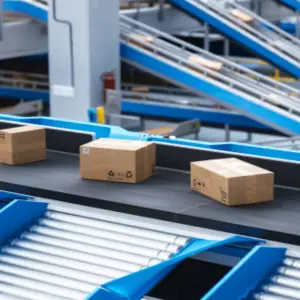
The Role of Conveyor Systems in Distribution Centers
A fully integrated distribution center conveyor system automates the flow of materials across all operational stages—receiving, storage, order picking, sorting, packing, and dispatch.
By replacing manual movement with automated handling, conveyors help distribution centres:
- Maintain continuous, organized product flow
- Speed up order fulfillment cycles
- Improve accuracy and reduce human errors
- Lower operational costs and labour dependency
With the right system in place, facilities benefit from faster turnarounds, better service levels, and greater scalability.
Types of Conveyor Systems Used in Distribution Centers
Choosing the right system is essential to building reliable, scalable, and high-speed distribution center conveyor solutions. Each conveyor type serves a unique role in optimizing product flow and reducing manual touchpoints.

Belt Conveyors
Best for: Continuous transport of lightweight to medium packages
Belt conveyors are the backbone of many distribution center conveyor systems. They provide a smooth, continuous surface that efficiently moves products along straight paths, curves, or inclines. Perfect for transporting cartons, polybags, and totes across various zones.
Slider Bed Conveyors
Best for: Light-duty applications and items with soft bottoms
Slider bed conveyors use a smooth surface under the belt to minimize friction. These are excellent for transporting smaller or fragile items gently and quietly.
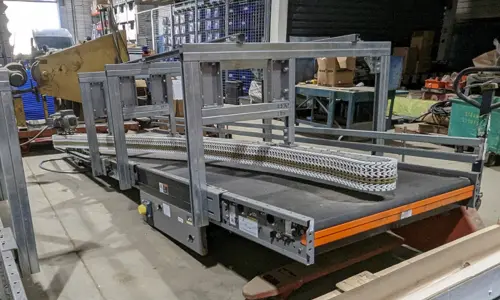

Vertical Conveyors (Spiral or Lift Systems)
Best for: Multi-floor distribution centers with limited floor space
Vertical conveyors move products between floors or mezzanine levels, allowing you to optimize space without compromising flow. Spiral conveyors are often used for high-volume, space-saving vertical transport.
Sortation Conveyors
Best for: High-speed item routing and order accuracy
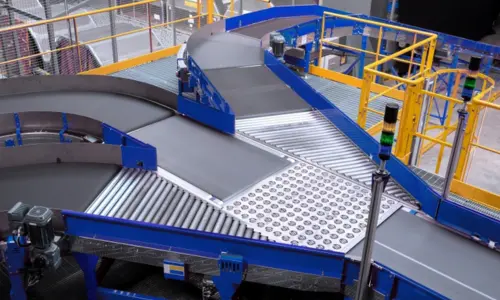
Sortation conveyors automatically identify and divert products to their correct destinations based on barcode, RFID, weight, or dimensions. They’re key to building fast, accurate distribution center conveyor systems for e-commerce and high-SKU operations.
Powered Roller Conveyors
Best for: Medium to heavy loads, accumulation zones
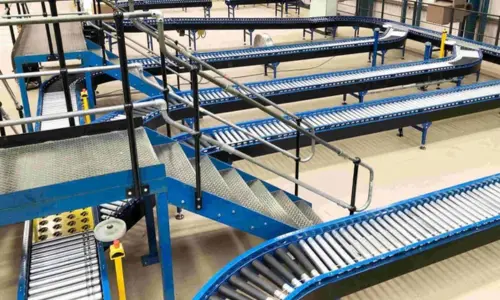
Powered roller conveyors use motorized rollers to move items along the path. These are ideal for zones where items need to slow down, queue, or merge—without stopping the entire line.
Applications of Conveyor Systems in Distribution Centers
Our distribution center conveyor solutions are tailored for high-efficiency operations across all critical workflows:
Receiving Move
incoming goods from unloading docks to inspection areas
Storage Integration
Transport goods to racking or automated storage zones
Order Picking
Deliver SKUs to picking zones or operators efficiently
Sorting
Automatically route items to staging or packing lanes
Dispatch
Facilitate fast, accurate truck loading for shipment
Put point wise
Benefits of Distribution Center Conveyor Systems
Faster Throughput – Improve cycle times with continuous automated movement
Improved Order Accuracy – Reduce mistakes with barcode-driven sortation
Lower Labour Costs – Minimize manual handling and reduce repetitive work
Scalability – Easily expand your system with modular conveyor components
Space Optimization – Free up space with vertical conveyors and tighter layouts
System Control & Integration – Integrate with WMS, sensors, and tracking tools
Challenges Faced Without Conveyor Systems
Operating a distribution center without conveyor automation introduces a range of inefficiencies and risks:
| Challenge | Impact |
| Manual Handling Bottlenecks | Moving goods manually between zones slows down order fulfillment and increases strain on workers. |
| Higher Labor Dependency | Without distribution center conveyor systems, more staff are needed for repetitive transport tasks, increasing overhead costs. |
| Increased Error Rates | Manual routing and sorting are more prone to errors, leading to mispicked or misrouted orders. |
| Lower Throughput Capacity | Manual methods can’t match the speed and consistency of automated conveyor solutions, limiting order volume and output potential. |
| Limited Scalability | As demand grows, manual processes struggle to scale efficiently without a conveyor backbone. |
Why Choose Us for Distribution Center Conveyor Systems?
At Synergy Automatics, we engineer and manufacture custom conveyor systems for distribution centers—built to fit your operation’s layout, throughput, and growth goals.
15+ Years of Expertise in automated material handling
Manufacturing + Engineering under one roof
Tailored designs for real-world distribution center challenges
Integrated control systems and support for complex flows
Built for performance, uptime, and future expansion
FAQs
Do you integrate your conveyors with automation or control systems?
Yes. We offer automated distribution center conveyor solutions with full control system integration, including PLCs, sensors, variable-speed drives, and real-time monitoring tools. This ensures precise flow control and data-driven performance.
Are your conveyor systems made in India?
Yes. All of our distribution center conveyor systems are manufactured at our facility in India, ensuring cost-efficiency, quick delivery, and full quality control from design to deployment.
What maintenance is required for distribution center conveyors?
Routine maintenance includes belt inspections, roller alignment, motor checks, and software diagnostics. Synergy Automatics provides full documentation, training, and maintenance support for all systems we deliver.
Do you offer sortation conveyor solutions?
Absolutely. We manufacture sortation conveyors equipped with diverters, pop-up wheels, barcode scanners, and more—ideal for high-speed routing in outbound shipping and order consolidation zones.
What maintenance is required for distribution center conveyors?
Routine maintenance includes belt inspections, roller alignment, motor checks, and software diagnostics. Synergy Automatics provides full documentation, training, and maintenance support for all systems we deliver.
How scalable are your conveyor systems for future expansion?
Our systems are modular and fully scalable. Whether you’re adding a new picking line, expanding capacity, or integrating automation, we design distribution center conveyor solutions that grow with your business.
Can Synergy Automatics design a custom conveyor system for my distribution center?
Yes. At Synergy Automatics, we specialize in designing and manufacturing custom distribution center conveyor systems tailored to your space, volume, and operational needs. Our solutions include layout planning, engineering, controls, and post-installation support.
What type of conveyor is best for a distribution center?
The ideal conveyor type depends on your product size, throughput, and layout. Common types include:
• Belt conveyors for general transport
• Sortation conveyors for routing packages by zone or carrier
• Powered roller conveyors for heavy items and accumulation
• Vertical conveyors for multi-level movement
Each plays a role in a complete distribution center conveyor system.
How do distribution center conveyor solutions improve operational efficiency?
Modern distribution center conveyor solutions reduce manual handling, automate routing and sortation, and enable real-time product flow. This results in faster order processing, improved accuracy, and lower labor costs—especially critical in high-volume environments.