
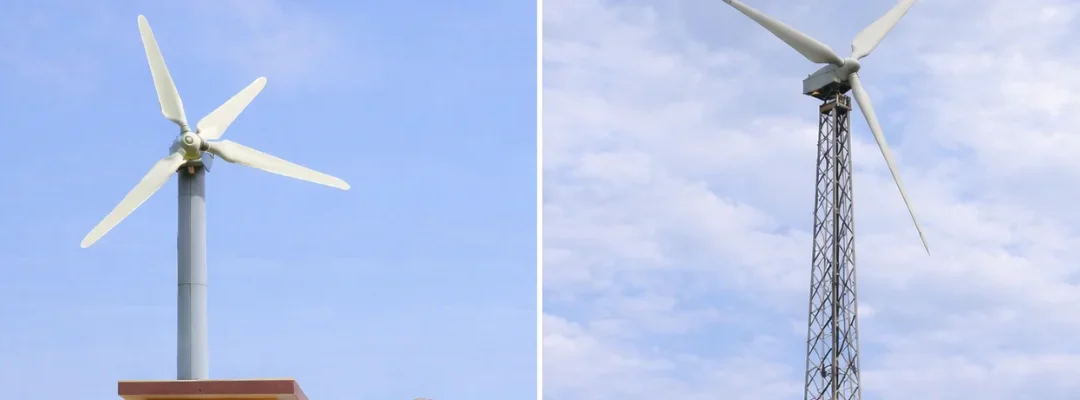
If you are choosing between a rooftop wind turbine and a tower-mounted wind turbine, the simple truth is:
A tower installation is usually better.
Not because rooftops can’t work, but because rooftops often have turbulent wind, and small wind turbines need smooth, clean wind to make useful electricity.
This guide explains the difference in basic English, so you can avoid a setup that spins but produces very little power.
Why tower wind usually performs better
1) Wind is stronger higher up
Wind speed usually increases with height. Higher wind also tends to be less turbulent. That is why small-wind guides recommend putting turbines on a tower, not low near obstacles.
2) Turbulence is the biggest rooftop problem
On many roofs, wind hits parapet walls, water tanks, nearby buildings, and trees. The wind becomes uneven and “dirty.” This can cause:
- lower energy production
- more vibration and noise
- faster wear on parts
Guidance for small wind strongly focuses on avoiding obstacles and turbulence.
3) Height rules (easy rule of thumb)
A widely used rule is:
The bottom of the rotor blades should be at least 9 m (30 ft) above any obstacle within 90 m (300 ft).
Most rooftops cannot meet this rule, especially in towns and cities.
Rooftop wind turbine: pros and cons
Rooftop pros
- No need for a separate tower in the yard (sometimes)
- Shorter cable run
- Easier to “install” in a limited space (in some cases)
Rooftop cons (the big ones)
- Wind is often turbulent (low output)
- Vibration can travel into the building (noise complaints)
- Structural safety becomes more sensitive (mounting strength matters)
- Maintenance at roof edge can be risky
Bottom line: Rooftop wind can look easy, but it is often unpredictable.
Tower wind turbine: pros and cons
Tower pros
- Cleaner wind at height (better kWh)
- Easier to follow siting rules (above obstacles)
- More stable mounting (less vibration into the home)
- Better long-term performance when properly sited
A small increase in tower height can increase output a lot. One consumer guide gives an example where raising a 10 kW turbine from 60 ft to 100 ft increased total system cost by about 10% but produced about 29% more power.
Tower cons
- Needs space, setbacks, and permissions
- Needs a foundation (civil work)
- Higher up-front cost than many rooftop attempts
- Maintenance planning is important (access, lowering, service)
Which one should you choose?
Choose a tower if:
- You want real, dependable generation (kWh)
- You have space for a tower and safe setbacks
- You can install high enough to clear nearby obstacles
- You want lower turbulence and better long-term reliability
Consider rooftop only if ALL are true:
- Your roof is high and very open (few surrounding buildings/trees)
- You can mount the turbine above roof turbulence (not just near a corner)
- A structural engineer/qualified installer confirms the roof can handle loads and vibration
- You accept that output may still be lower than expected
If you are surrounded by buildings, rooftop wind is usually a poor bet.
Quick comparison table
| Factor | Rooftop installation | Tower installation |
|---|---|---|
| Wind quality | Often turbulent | Usually cleaner |
| Energy output | Often unpredictable | More predictable (if sited well) |
| Noise/vibration | Higher risk | Lower risk (with good design) |
| Safety/structure | Needs careful roof engineering | Needs foundation + tower engineering |
| Maintenance access | Can be awkward at roof edge | Often easier with planned access |
| Best for | Rare, very open rooftops | Most serious home wind projects |
What to check before you decide (simple checklist)
A) Obstacle check
- Are there trees/buildings near the turbine area that will disturb wind?
- Can you meet the “9 m above obstacles within 90 m” rule?
B) Wind at height
- Do you have a wind estimate at the hub height you can install?
- Don’t size a turbine using wind data from a much higher height you can’t reach.
C) Mounting and vibration
- Rooftop: can the roof handle vibration and loads safely?
- Tower: is the foundation and tower design engineered for wind loads?
D) Maintenance plan
- Who will service it?
- How will you access it safely?
- Is there a safe shutdown/isolation method?
Common mistakes (why projects disappoint)
- Installing on a rooftop corner because it’s “easy”
- Buying based on “rated kW” without checking wind quality and turbulence
- Ignoring the obstacle/height rule
- No plan for vibration, noise, and maintenance