Off-Grid Wind Turbine for Home
Synergy Automatics provides complete planning and implementation support for an off-grid wind turbine for home, including site assessment, sizing, mounting planning, battery integration, and commissioning. This page is built for homeowners who need a practical wind-based backup or independent power solution in suitable airflow locations.
Off-Grid Home Wind Power System Solutions
An off-grid home wind power system is a battery-based setup where wind energy is generated, controlled, stored, and then supplied to selected household loads through an inverter. Synergy Automatics designs these systems based on site conditions, backup requirement, and essential load planning.
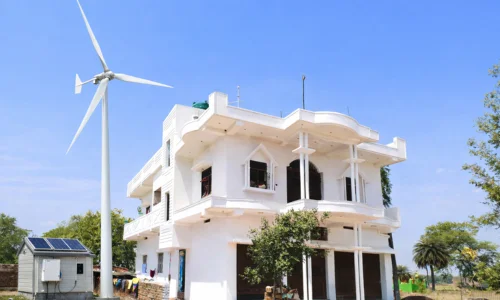
Site and airflow review
Turbine type selection (VAWT / HAWT)
Capacity planning for backup needs
Battery and inverter integration
Mounting and structural coordination
Testing, commissioning, and service support
Benefits of a Residential Off-Grid Wind Turbine
A residential off-grid wind turbine is a strong option for homes backup power support and better energy independence. When planned properly, it improves power reliability and supports essential household operation.
Backup support during outages
Battery charging from renewable wind energy
Useful for low-grid or no-grid properties
Can be planned for essential circuits only
Can be integrated with solar later (hybrid-ready design)
Scalable from compact to larger home requirements
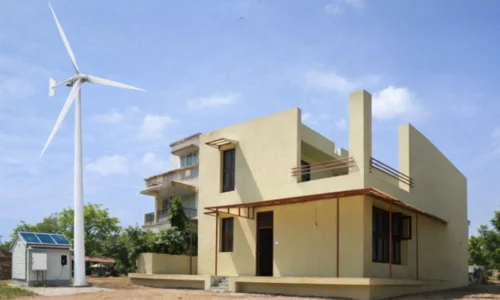
Application of Standalone Wind Turbine for House
A standalone wind turbine for house projects works best in properties with good airflow, mounting feasibility, and a clear backup-use plan. Synergy Automatics recommends site-based planning before finalizing system size.
Farmhouses and Open-Plot Homes
Open sites usually offer better wind movement and easier mounting options.
Villas and Independent Houses
Suitable for homes that want battery backup support for lights, fans, and essential circuits.
Semi-Rural Properties
Useful in locations where grid power is unstable and renewable backup support is needed.
Remote or Low-Grid Homes
A good fit where the property needs a more self-reliant power setup.
Homes Planning Hybrid Expansion
Wind-only off-grid systems can be designed for future solar integration.
Small Off-Grid Wind Turbine Capacity Options
A small off-grid wind turbine can be used for battery charging and essential load support, while larger sizes are used for stronger backup performance. Synergy Automatics sizes the system based on real usage, not only turbine rating.
- 1kW – light loads and basic battery support
- 2kW – moderate backup use
- 3kW – mid-level household backup
- 5kW – larger homes, villas, and stronger backup support
Why Choose Synergy Automatics for Off-Grid Wind Projects
Synergy Automatics delivers practical, site-based solutions for homeowners planning an off-grid wind turbine for home setup. Instead of generic product recommendations, we focus on airflow conditions, backup needs, battery sizing, and safe integration—so your system performs reliably in real use.

Site-first planning based on airflow, mounting feasibility, and property conditions
Load-based sizing for essential circuits, backup duration, and future expansion
Turbine selection support for both VAWT and HAWT residential applications
Battery and inverter integration planning for a stable off-grid home wind power system
Safe installation coordination with proper mounting, wiring, and protection setup
Hybrid-ready design approach if you want to add solar later
Service-focused support for long-term performance and maintenance planning
Synergy Automatics helps you build a domestic off-grid wind energy system that is matched to your home, not just the turbine rating.
FAQs – Off-Grid Wind Turbine for Home
1) What is an off-grid wind turbine for home?
An off-grid wind turbine for home is a wind-powered system that works with a charge controller, battery bank, and inverter to supply electricity without depending on direct grid connection.
2) How does an off-grid home wind power system work?
The turbine generates power from wind, the controller regulates it, batteries store it, and the inverter converts it into usable power for home appliances and essential circuits.
3) Does a home wind turbine without grid connection need batteries?
Yes, in most cases. A home wind turbine without grid connection needs batteries to store energy and provide stable output when wind speed changes.
4) Can a residential off-grid wind turbine run a full house?
It can, but only if the turbine size, battery bank, and inverter are planned for full-house demand. Many homes use it mainly for essential loads and backup support.
5) What size small off-grid wind turbine is suitable for a home?
A small off-grid wind turbine (like 1kW or 2kW) is usually used for light loads, charging, and backup circuits. The right size depends on your daily usage and backup hours.
6) Is a standalone wind turbine for house better than a grid-connected system?
It depends on your need. A standalone wind turbine for house is better when you want battery-based backup or more energy independence, while grid-connected systems are often used for daily renewable support.
7) Can I use solar panels with an off-grid wind system?
Yes. Wind and solar can work together in a hybrid setup. This is a common upgrade for a domestic off-grid wind energy system because it improves charging support across day and night.
8) What appliances can an off-grid wind system run?
It depends on system size. Common uses include lights, fans, charging points, TV, Wi-Fi, and selected appliances. Larger systems can support more loads if designed properly.
9) What affects off-grid wind performance the most?
Airflow quality, mounting height, turbine type, battery capacity, inverter sizing, and proper system design are the main factors.
10) Is rooftop installation possible for off-grid wind turbine for home systems?
Yes, in some houses. But structure strength, vibration control, and airflow quality must be checked before choosing rooftop mounting.
11) Which is better for off-grid use VAWT or HAWT?
It depends on the site. VAWT may suit compact or variable-airflow locations, while HAWT is often better for open areas with cleaner wind flow.