
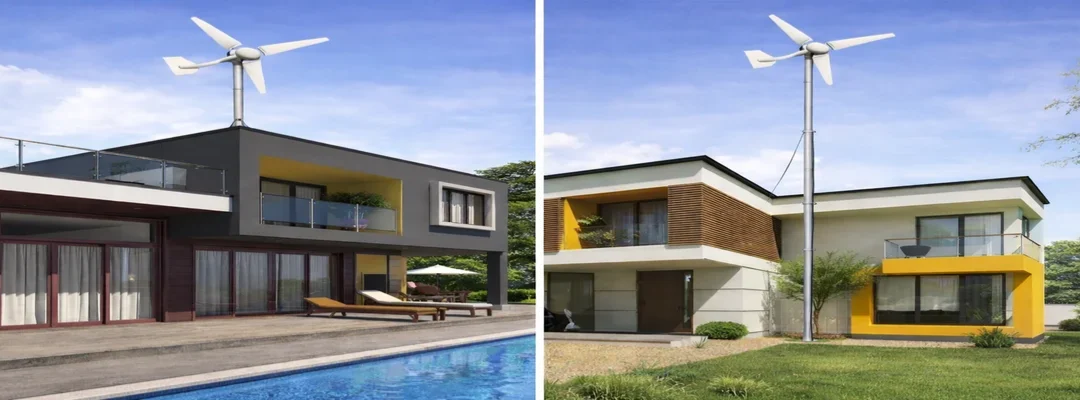
Buying a home wind turbine before checking your wind is the fastest way to waste money. Many turbines “spin,” but they do not make useful electricity because the wind is too weak, too turbulent, or too low at rooftop height.
This guide shows a safe, low-cost way to check wind potential step by step—so you only spend money when the site is truly suitable.
Step 1: Be clear about your goal (so you don’t overspend)
Before checking wind, decide what you want wind to do:
- Small support (lights, fans, battery charging)
- Backup support (hybrid with solar + batteries)
- Big bill reduction (harder and needs stronger wind + tower)
The bigger the goal, the more you need:
- stronger average wind
- higher tower
- larger rotor (not just “rated kW”)
Step 2: Do a “site exposure” check (free and very important)
Stand where you think the turbine would go and look around.
Good signs
- Open land in at least one main direction (fields, coast, hill edge)
- Few tall buildings or trees nearby
- You can place a turbine away from obstacles
Bad signs (common in cities)
- Buildings on all sides
- Tall trees close to the house
- Narrow streets and dense construction
- The only available place is a rooftop corner
Why this matters: obstacles create turbulence. Turbulence reduces power and increases vibration/noise.
Step 3: Don’t trust “it feels windy” — check wind data first (free)
Before spending on equipment, use free wind maps or wind tools to get a rough idea of average wind speed in your area.
What to do:
- Check wind speed at different heights (if the tool allows)
- Compare your location with nearby open areas
- Use this only as a first filter (maps can’t see your exact trees/buildings)
Important: Wind maps show the region. Your property can still be worse (or better).
Step 4: Check if you can install proper height (this decides most projects)
Home wind usually works best on a tower (or pole) because it reaches cleaner wind.
Ask yourself:
- Can you legally and safely install a tower/pole?
- Do you have space for safe setbacks?
- Can you access it for maintenance?
If the answer is “no,” and your only option is rooftop mounting, wind becomes much more risky in most residential areas.
Step 5: Avoid the rooftop wind trap (simple explanation)
Rooftops often have:
- parapet walls
- tanks
- nearby buildings
- uneven airflow
This creates turbulence, which causes:
- low energy production (even if it spins fast)
- noise and vibration
- faster wear on parts
Rooftop wind is only worth considering when the roof is very open and high, and the mounting is engineered properly.
Step 6: Do a quick “obstacle distance” test (simple rule)
Wind turbines need space from obstacles. If your turbine location is close to tall objects (trees/buildings), wind becomes disturbed.
Check:
- The height of the nearest obstacles (trees/buildings)
- How close those obstacles are to the turbine location
- Whether you can place the turbine high enough above them
If you cannot get above obstacles, wind output will likely be poor.
Step 7: If the site looks promising, measure wind (the best way to avoid waste)
If you’re serious about spending on wind, the safest step is to measure wind near the height you plan to install.
What matters in measurement
- Measure average wind, not just maximum gusts
- Measure for long enough to see patterns (weeks to months; longer is better)
- Place the sensor in the cleanest airflow you can (not behind walls/trees)
Why measure: A small difference in average wind speed can cause a big change in energy output. Measurement prevents “hope-based buying.”
Step 8: Compare your results to realistic expectations
A good check is to ask:
- Is the wind strong most days, or only sometimes?
- Is the wind smooth, or does it change direction and speed suddenly?
- Can you realistically install at the measured height?
If the wind is borderline, a common smart approach is:
- Use solar as the main source
- Add wind only if the site is clearly good (open + strong + tower feasible)
Common ways people waste money on home wind
- Buying a turbine before checking wind at height
- Installing on a rooftop corner in turbulent airflow
- Choosing by “rated kW” instead of expected annual energy (kWh/year)
- Not planning for tower height, permissions, and maintenance
- Expecting gusts to make up for low average wind
- No safety plan (braking, shutdown, lightning protection, earthing)