
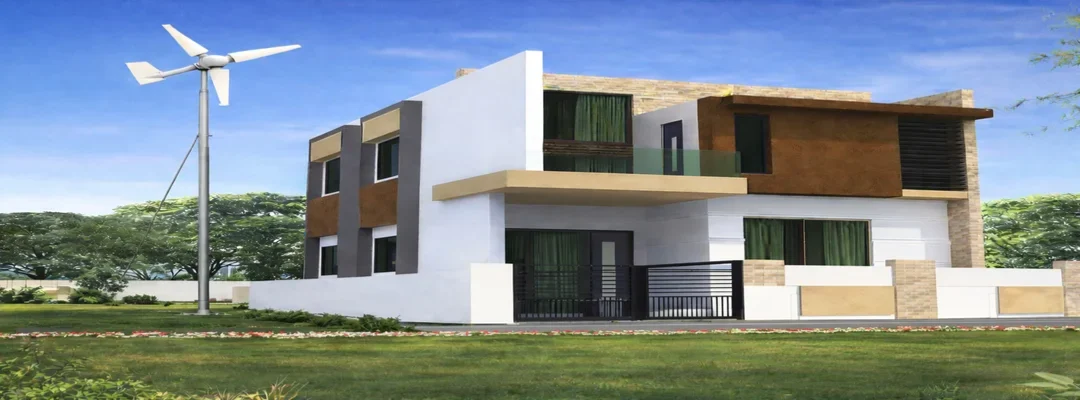
A small wind turbine can be a strong addition for the right Indian sites—especially open coastal belts, farms, and exposed hill slopes. But for many homes (particularly in dense towns and cities), wind underperforms because the wind resource at usable height is weak or turbulent, and the turbine can’t be installed high enough to access clean airflow.
This guide explains how to evaluate your location using India-specific references and criteria, so you can decide whether wind is worth considering—or whether solar (or solar-first hybrid) is the safer investment.
Step 1: Identify which wind system you are evaluating
In India, small wind projects generally fall into two categories:
- Water pumping windmills (mechanical pumping)
- Small aerogenerators / wind-solar hybrid systems (electricity generation, often paired with batteries)
MNRE’s “Small Wind Energy and Hybrid Systems” programme includes different site guidance depending on the application.
If your goal is home electricity, you should evaluate your site using the aerogenerator / wind-solar hybrid criteria.
Step 2: Check official Indian site-selection criteria (MNRE baseline)
MNRE’s programme guidelines provide clear, practical screening criteria:
For small aerogenerators / wind-solar hybrid systems (electricity)
- The site should be free from obstacles like tall trees, high buildings, and transmission lines within ~100 m
- The site should preferably have annual average wind speed ~15 km/h (4.17 m/s) or above at 20 m height
- Wind speed should be obtained from C-WET/NIWE or another agency using actual wind data or tools like Wind Atlas (as referenced in the guideline)
- Foundations should be designed considering soil bearing capacity
For water pumping windmills
- Similar obstacle guidance (clear area within ~100 m)
- Annual average wind speed more than 10 km/h
Why this matters: This MNRE benchmark (~4.17 m/s at 20 m) is a practical India-specific reality check. If your site can’t plausibly meet it at a realistic mounting height, wind often becomes a high-risk purchase.
Step 3: Use NIWE wind maps for preliminary assessment (India resource check)
Before you measure anything on-site, use NIWE’s official resource portal to understand whether your district/region is broadly wind-supportive.
NIWE provides wind maps (including a 20 m wind map) and states these maps are intended as a basis for preliminary site assessment.
How to use the maps correctly
- Use them as a regional filter, not a final decision.
- Compare your location to nearby zones: if your surrounding region is generally low-wind on the map, a small turbine is less likely to be worth it.
- Remember: maps can’t “see” your local obstacles (trees/buildings) that create turbulence and reduce output at the property level.
MNRE also references NIWE’s role in wind resource assessment and identification of potential sites in India.
Step 4: Do a property-level obstruction and turbulence check (most important step)
Even in a windy district, your turbine can underperform if it sits in disturbed airflow.
What to check around your site
Using MNRE’s own siting guidance as a starting point:
- Are there tall trees, buildings, or transmission lines within ~100 m of the proposed turbine location?
- Is the upwind direction open (fields/coast) or blocked (dense construction)?
Rooftop vs tower reality (why many home turbines disappoint)
Rooftops often have turbulence caused by parapet walls, tanks, neighboring structures, and uneven wind flow. Even if wind “feels strong” at times, turbulent air reduces energy and can increase vibration/noise. Practically, if you can’t place the rotor in cleaner airflow at height, the site usually isn’t suitable for meaningful generation.
Step 5: Confirm whether a tower/pole installation is actually feasible
For Indian residential settings, feasibility usually depends on:
- Space and setbacks (safe clearance from property boundaries and nearby structures)
- Permissions/local constraints (varies by state, layout, and community rules)
- Foundation and structure (civil works matter more than people expect)
MNRE’s guideline explicitly calls out foundation design with respect to soil bearing capacity, which signals that small wind is a civil + structural project, not just an electrical add-on.
Step 6: If the project cost is meaningful, plan wind verification (don’t rely on “feels windy”)
NIWE’s micro-siting guidance (used for project evaluation) emphasizes:
- wind statistics at hub height or measurement height
- the need for full-year statistics
- checking authenticity and integrity of wind data
And NIWE’s measurement guideline for private developers highlights that formal wind resource assessment typically expects measurements at a minimum of 50 m, and a period adequate to cover one full year.
Homeowner-friendly interpretation:
You may not install a 50 m met mast for a small home system—but these NIWE documents make one message clear: wind decisions should be based on verified data at height, not casual observation. If your site is borderline, measurement (or professional verification) is what prevents expensive underperformance.
Step 7: Safety and structural compliance (India-specific)
A wind turbine imposes wind loads on the structure. In India, wind load design is addressed under IS 875 (Part 3) (wind loads on buildings and structures), adopted by BIS.
For homeowner projects, this typically means:
- structural design/verification by a qualified professional
- proper earthing and lightning protection
- overspeed/shutdown protections and safe isolation
- planned access for maintenance (because small turbines have moving parts)
Practical decision outcomes (what to do after the checks)
Proceed toward wind (good candidate) if:
- NIWE maps suggest your area is wind-supportive, and
- your property can meet MNRE-style siting logic (low obstacles within ~100 m), and
- you can realistically install at height, and
- wind speed is likely around ~15 km/h (4.17 m/s) at ~20 m or verified near that range
Choose solar (or solar-first hybrid) if:
- you’re in dense surroundings and can’t clear obstacles/turbulence, or
- tower installation is not feasible, or
- your wind resource is not verifiable at usable height
Choose hybrid (solar + wind) when:
- your wind and solar resources are complementary (MNRE notes this preference for hybrids) and your wind checks pass
What to collect before you ask for a site assessment (makes the answer accurate)
MNRE’s guideline notes that users/manufacturers may need to provide latitude-longitude and other parameters for wind estimation/verification.
Prepare:
- Exact site pin / latitude-longitude
- Photos in all directions from the proposed location (show obstacles)
- Approx. distances to tall trees/buildings/transmission lines (up to ~100 m)
- Whether a tower/pole is possible and the height you can realistically install
- Your load goal (monthly units + backup needs)