
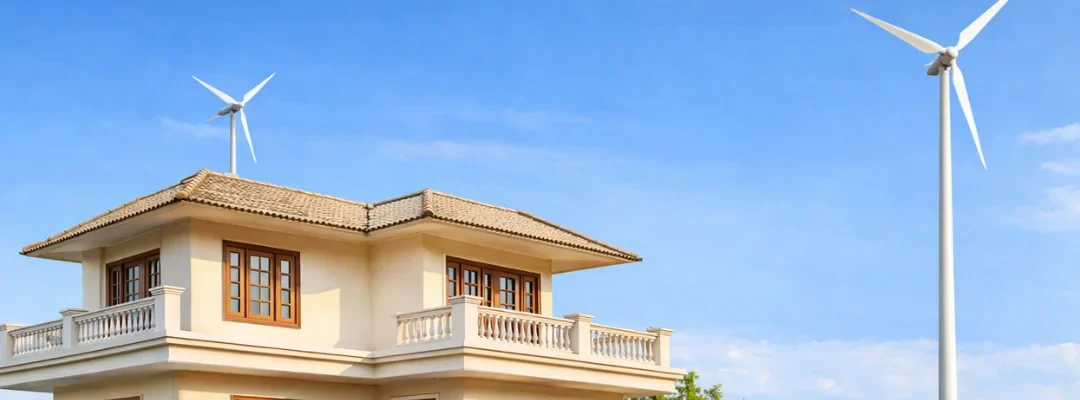
When people say a home wind turbine “didn’t work,” the problem is often not the turbine. It’s the height.
A wind turbine needs clean, steady wind. Near the ground (and around buildings), wind is usually weaker and more “messy.” The higher you go, the wind is often faster and smoother—which usually means more electricity and fewer problems.
This post explains, in basic English, why tower height usually beats rooftop mounting, what “good height” really means, and how to decide what works for your home.
Why height matters more than most people think
Wind changes a lot with small height differences
Wind power rises very fast as wind speed increases. Many references explain this in a simple way: wind power is linked to the cube of wind speed (so more wind speed can mean much more power).
That’s why:
- A turbine that is just a bit higher can produce noticeably more energy.
- A turbine stuck in slow, turbulent wind can spin but produce very little useful electricity.
Turbulence is the hidden problem
Turbulence means wind that keeps changing direction and speed. It’s common near:
- roof parapet walls
- water tanks and pipes
- nearby buildings
- trees
Turbulent wind reduces output and can increase noise, vibration, and wear.
Rooftop wind turbine height: what usually happens
A rooftop wind turbine sounds simple: “I already have a roof, so I don’t need a tower.” But roofs often have bad wind quality.
Rooftop can work when…
Rooftop wind is most likely to work if your roof is:
- very open and high
- far from nearby buildings and tall trees
- engineered for loads and vibration (mounting matters)
Rooftop often fails when…
Rooftop wind is risky when:
- you live in a dense area (buildings all around)
- trees are close to the roof
- the turbine is placed near a roof edge, corner, or tank area
- the turbine is mounted low (close to the roof surface)
The common result: the turbine spins, but the energy output is unstable and usually lower than expected.
Tower height: why it usually wins
A tower gives you one big advantage: you can lift the turbine above obstacles and turbulence.
Most small-wind guidance pushes the same idea: if you want wind power that feels “real,” you need clean airflow at height.
The most useful height rule (easy to remember)
A widely used rule of thumb is:
Place the turbine so the bottom of the blades is at least 30 ft (9 m) above anything within 300 ft (90 m).
This single rule explains why rooftops struggle:
- In many neighborhoods, there are obstacles within 90 m (trees, buildings).
- Roof height often doesn’t clear those obstacles by an extra 9 m.
A real example: why extra height is often worth it
A consumer guide for small wind gives this practical comparison:
Raising a 10 kW turbine from a 60 ft tower to a 100 ft tower increased total system cost by about 10%, but it could produce about 29% more power.
This is why tower height is not a “nice-to-have.” It can be the difference between:
- “It spins sometimes” and
- “It generates meaningful energy”
So what is the “best height” for your home?
Instead of asking “roof or tower?”, ask these three questions:
1) What are the tallest obstacles near your turbine spot?
Examples: trees, buildings, tanks, roof walls.
2) How close are they?
Obstacles close to the turbine cause more disturbed wind.
3) Can you place the turbine clearly above them?
Use the 30 ft / 300 ft rule as your target.
If you can’t reach clean wind above obstacles, wind becomes a risky investment.
Roof vs tower: simple comparison
Roof mounting is usually best when:
- your roof is unusually open and high
- there are few nearby obstacles
- you have a strong mounting plan and accept lower output risk
Tower mounting is usually best when:
- you want better and more stable energy production
- you can install high enough to clear obstacles
- you have space for setbacks and a safe maintenance plan
The practical downsides of towers (be honest before you choose)
Towers can be the best solution, but they come with real requirements:
- space and safe setbacks
- a foundation (civil work)
- permissions and safety planning
- maintenance access (how you will service it)
The good news: if you plan this properly, tower wind is usually the option with the best chance of success.
What to do if you can’t build a tower
If you can’t install height and clean airflow, you have three smart options:
Use wind only for small support goals (and accept limited output)
Skip wind and go solar (often more predictable)
Do solar first, then add wind only if you later confirm a good tower site
FAQ
Is a rooftop wind turbine ever a good idea?
Sometimes, but only on very open, high roofs with minimal nearby obstacles and proper structural mounting. Otherwise, turbulence often reduces output.
Why does a small height increase matter so much?
Because wind power rises quickly with wind speed (often explained as wind speed cubed), and wind is usually better higher up.
What’s the simplest height guideline?
Bottom of blades at least 9 m (30 ft) above any obstacle within 90 m (300 ft).